Blog
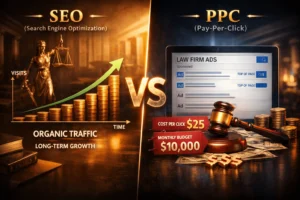
Law Firm SEO vs PPC: Which Generates More Legal Clients in 2026?
Law firm seo vs ppc Law Firm SEO vs PPC: Which Generates More Legal Clients in 2026 Book a Free Strategy Call See Case Studies
We now offer Free AI Visibility Audits. Find out if ChatGPT, Perplexity & Google AI can find your business. Claim yours →

By Saumya Patel | Content Writer | 4+ Years of Industry Experience | Last Updated: 2026 | ~15 min read
Choosing the right digital marketing agency USA comes down to five weighted factors: transparency, proof, fit, process, and contract terms. Score any agency against those five — not their pitch deck — and the decision becomes obvious. In 2026, most legitimate small-business engagements run $1,500–$5,000/month, and 39% of CMOs are actively trying to reduce what they pay agencies — which tells you the real risk isn’t underspending, it’s overpaying for opacity.
Every agency promises “growth,” “ROI,” and “leads.” That makes the words useless as a filter. What separates a real partner from an expensive guess isn’t the pitch — it’s whether five specific things are true, and most buyer’s guides on this topic never tell you how to actually check.
This guide gives you a scored system — the Agency Vetting Scorecard — plus the exact questions to ask and what a red-flag answer sounds like, so you’re evaluating evidence instead of confidence.
Before comparing agencies, define what you actually need. Do you want more local leads from Google Maps? Are you struggling to convert existing website traffic? Do you need consistent social engagement, or a full rebuild of your digital presence? A clear objective tells you which skill set to shop for — SEO, PPC, social, or full-service — and prevents you from being sold a bundle you don’t need.
Score a prospective agency across five weighted categories. This turns a sales conversation into a comparable evaluation:
| Category | Weight | What ‘good’ looks like |
|---|---|---|
| 1. Transparency | 25 | Live dashboard access, plain-language reporting, no hidden fees |
| 2. Proof | 25 | Named case studies with real, attributed metrics — not vague claims |
| 3. Fit | 20 | 2–3+ clients in your industry or a comparable business model |
| 4. Process | 20 | Can explain the strategy clearly before you sign — not after |
| 5. Contract terms | 10 | Reasonable term (3–6 months), clear exit clause, no rankings/results guarantee |
The rule: if an agency scores well on Proof and Process but poorly on Transparency, walk away. A great pitch with no visibility into ongoing performance is how businesses end up locked into a retainer they can’t evaluate.
How can I tell if a marketing agency’s results are real?
Direct answer: Ask for a named case study with attributed, verifiable metrics — not a general claim like ‘we grow traffic.’ A credible agency can show you the starting baseline, the specific timeframe, and the tracking tool used to measure the result. If they can’t name the client, the timeframe, or the measurement method, treat the number as marketing copy, not evidence.
Ask directly: what’s your process for tracking ROI and lead quality? Can I see a case study with real metrics? How do you report results — weekly, monthly, or live dashboards? Vague success stories with no numbers, or numbers with no source, are the single biggest tell that you’re being sold rather than informed.
A strong agency doesn’t just know the tools — it knows how to use them together, and it can prove that with specifics, not adjectives. A useful checklist:
What’s a fair budget for a small business digital marketing agency?
Direct answer: Most legitimate small-business engagements run $1,500–$5,000 per month, with $2,500–$5,000 being the most common range for a meaningful single-to-two-channel scope (e.g., SEO plus content, or standalone PPC management). Full-service packages covering SEO, PPC, content, and social typically run $3,500–$8,000/month. A rough budgeting rule: small businesses generally allocate 3–5% of annual revenue to marketing.
| Engagement type | Typical 2026 monthly range |
|---|---|
| Single-channel (e.g., local SEO) | $1,000–$3,000 |
| Focused 1–2 channel retainer | $1,500–$5,000 |
| Full-service (SEO + PPC + social + content) | $3,500–$8,000 |
| PPC management fee | 10–20% of ad spend, often with a $2,500 minimum |
The number worth sitting with: agencies account for roughly 21% of the average marketing budget, and 39% of CMOs are actively trying to reduce that share (Gartner, 2025). That’s not a reason to underspend — it’s a reason to demand clarity on exactly what the fee buys before you sign, since price alone rarely tracks with quality.
Not every polished, award-badge-covered agency is trustworthy. Watch for:
Always request a strategy outline before signing. If they can’t explain the plan clearly before you’re a client, they can’t execute it properly after you are.
Digital marketing isn’t “set it and forget it.” Expect weekly or bi-weekly updates covering campaign health, lead flow, and next steps. At minimum, ask for: live analytics dashboard access (GA4, Google Ads, your CRM), a monthly ROI summary in plain language, and recorded strategy calls you can revisit. If reporting requires you to request it rather than receive it automatically, that’s a preview of how responsive the relationship will be.
SEO, automation, and social proof all take months to mature — an agency selling a one-time campaign with no ongoing optimization is selling you a snapshot, not growth. Look for a partner that emphasizes sustainable improvement over time, and one that explains its reasoning as it works rather than treating strategy as a black box. Agencies that educate you along the way tend to deliver stronger long-term results, because knowledge-sharing and accountability tend to travel together.
| # | Question to ask | What to expect |
|---|---|---|
| 1 | What’s your experience in my specific niche? | At least 2–3 comparable clients, named |
| 2 | How do you measure ROI? | Specific tools — GA4, CRM, call tracking — not ‘we track everything’ |
| 3 | Who actually executes the campaigns? | Named in-house team or certified specialists, not anonymous |
| 4 | What’s the minimum contract term? | 3–6 months is reasonable; longer with no exit clause is a flag |
| 5 | Can I see reporting from another client? | An anonymized real report, not a mockup |
Tarasaka is a digital marketing agency, which means this guide is written by a party with a stake in how you answer these questions — worth saying plainly. The scorecard above is designed to be used on any agency, including this one: ask us for named case studies with real metrics, ask what our reporting actually looks like, and hold our answers to the same five categories. An agency that welcomes that scrutiny is telling you something; one that doesn’t is telling you something too.
How long before I see results from a digital marketing agency?
Direct answer: Paid channels can show results within days to weeks. SEO and organic growth typically take 3–6 months to show measurable movement and 6–12 months to mature into stable, compounding results. Any agency promising fast, dramatic organic results in weeks is either overpromising or planning to use short-term tactics that risk long-term penalties.
Choosing the right digital marketing agency USA isn’t about picking the cheapest or the flashiest option — it’s about scoring transparency, proof, fit, process, and contract terms, and refusing to sign until an agency can back its pitch with specifics.
When you align with a team that treats data and communication as non-negotiable, marketing stops feeling like a gamble and starts producing results you can actually verify.
How do I choose the right digital marketing agency USA?
Score prospective agencies across five weighted factors: transparency (live reporting access), proof (named, sourced case studies), fit (relevant industry experience), process (a clear strategy explained before you sign), and contract terms (reasonable length, no results guarantees). Avoid choosing on price or pitch alone.
What's a fair budget for small businesses?
Most legitimate small-business engagements run $1,500–$5,000 per month, with full-service packages reaching $3,500–$8,000. A reasonable budgeting rule is 3–5% of annual revenue. Price varies 5–10x by agency tier and doesn’t track proportionally with quality — evaluate scope and proof, not just the number.
How long before I see results?
Paid channels can show results within days to weeks. SEO and organic growth typically take 3–6 months to show measurable movement and 6–12 months to fully mature. Be skeptical of any agency promising fast, dramatic organic results — it usually signals short-term tactics with long-term risk.
Is it better to hire one full-service agency?
Only if they’re genuinely strong across every channel you need. A full-service agency that’s mediocre at everything can underperform two focused specialists. Weight this decision against how the agency scores on Fit and Proof for each specific channel, not just overall reputation.
Yes, and you should insist on it. Direct access to GA4, ad platform dashboards, and your CRM lets you verify an agency’s reporting independently rather than relying solely on their summary — that access is itself a strong signal of a transparent partner.

Saumya Patel is a Content Writer at Tarasaka Digital Solutions with over 4 years of experience creating SEO-focused content for businesses across multiple industries. Her areas of expertise include SEO, Local SEO, AI SEO, AEO (Answer Engine Optimization), GEO (Generative Engine Optimization), content strategy, and digital marketing.
At Tarasaka Digital Solutions, Saumya researches search trends, analyzes ranking factors, studies AI search behavior, and creates evidence-based content designed to help businesses improve online visibility, attract qualified leads, and build long-term organic growth. His content is developed using industry best practices, competitor analysis, and real-world search marketing insights to ensure accuracy, relevance, and practical value for readers.
Law firm seo vs ppc Law Firm SEO vs PPC: Which Generates More Legal Clients in 2026 Book a Free Strategy Call See Case Studies

Local Businesses Rank In Google How Local Businesses Can Rank in Google AI Overviews in 2026 Book a Free Strategy Call See Case Studies FAQ
Local Law Firm SEO Law Firm SEO Guide: How Lawyers Rank #1 on Google Representative results from a client engagement. Identity protected by NDA. Book