Blog
Why 3 Companies Control 82% of Google Maps (And The Visibility Engineering™ Fix)
Roofing SEO Florida, USA The Florida Roofing Monopoly: Why 3 Companies Control 82% of Google Maps (And The Visibility Engineering™ Fix) Book a Free Strategy
We now offer Free AI Visibility Audits. Find out if ChatGPT, Perplexity & Google AI can find your business. Claim yours →
How to Win the Local 3-Pack
By Saumya Patel | Content Writer | 4+ Years of Industry Experience | Last Updated: June 12, 2026 | ~15 min read
Google ranks the local 3-pack on three factors: Relevance, Distance, and Prominence. Here’s what most guides miss — Distance is fixed, so the real leverage is Prominence (reviews, citations, engagement) and Relevance (categories, services, local pages). For roofers, reviews are the single biggest controllable lever, not a “Step 3” afterthought.
Every roofing Maps guide gives you the same 7 steps and treats them as equal. They’re not. Two of Google’s three ranking factors are barely in your control, and the steps that move the needle most are buried in the middle of the list.
This guide reorganizes Maps SEO around how Google actually ranks — using a proprietary model, the 3-Pack Leverage Map — so you spend effort where it changes rankings. For the full local picture, see our roofing SEO services guide.
What are the Google Maps ranking factors?
Google ranks local map results on three factors: Relevance (how well your profile matches the search), Distance (how close you are to the searcher), and Prominence (how well-known and trusted your business is, signaled by reviews, citations, and engagement). Distance is largely fixed; Relevance and Prominence are where roofers win or lose the 3-pack.
First principles: you can’t change where a searcher is standing, so Distance is mostly out of your hands. That means your entire competitive advantage lives in the two factors you can control — and most roofers spread effort evenly instead of concentrating it where it counts.
Rank your optimization effort by how much each factor moves — and how much direct control you have over it:
| Factor | Your Control | Biggest Levers | Effort Priority |
|---|---|---|---|
| Prominence | High | Reviews (volume, recency, responses), citations, engagement | Highest |
| Relevance | High | Primary category, services infrastructure, local pages, GBP completeness | High |
| Distance | Low | Service-area setup, multiple locations (if completely legitimate) | Structural Only |
The operational principle: pour your team’s effort into Prominence and Relevance — the factors you control — and stop obsessing over Distance, which you mostly cannot change. Reviews sit at the very top because they represent the strongest controllable Prominence signal available to modern roofers.
Reviews are the single most powerful controllable ranking signal in local map search — and they double as an immediate consumer conversion signal. Three specific dimensions matter: volume (a roofer with 150 reviews out-ranks one with 12), recency (a steady drip beats a stale pile), and responses (replying to every review signals high engagement to Google and deep trustworthiness to homeowners).
Relevance measures how perfectly your business profile matching metrics align with a homeowner’s explicit search request. You control this factor directly through account setup optimization:
While you cannot physically move your commercial headquarters closer to every active searcher, you can define your operational service areas correctly. If your business genuinely operates out of multiple brick-and-mortar storefronts, create a verified profile for each location. Never fake physical addresses to game distance metrics; Google regularly penalizes or suspends profiles for tracking falsified workspaces.
For most established contracting firms, Distance is a one-off structural setup task rather than an ongoing operational effort — which is exactly why you should not waste energy on it at the expense of active review generation and category relevance mapping.
Citations — which represent structural mentions of your company name, physical address, and phone number on platforms like Yelp, Angi, HomeAdvisor, BBB, and roofing-specific directories — validate your legitimacy to indexing bots. The foundational rule here is absolute consistency. Having identical Name, Address, and Phone (NAP) text strings across the web removes database confusion; conflicting information reduces engine confidence and suppresses maps exposure.
Routinely upload clear images of actual completed roofing projects, before/after storm repairs, and your field crews onsite. Frequent media updates correlate strongly with increased map placement performance and drastically lift active click-to-call rates. Homeowners are significantly more likely to trust a local contractor profile that visually proves real field operations.
Publish regular updates (such as seasonal storm preparation lists, featured recent roof installs, or quick maintenance checklists) to keep your account status active. While updates will not completely out-rank direct review signals on their own, an active, posting profile continuously logs positive engagement markers.
How long does it take to rank in Google Maps?
Most roofing companies see local ranking movement within 1–3 months of consistent optimization, with stronger results by 3–6 months as reviews and citations accumulate. Speed depends on local competition, profile completeness, and review velocity. A verified, complete profile in a less competitive market ranks faster than a new profile in a major metro.
The localized 3-pack sits prominently above traditional organic text links and instantly captures immediate “near me” search intent. These represent the absolute highest-converting roofing searches across the web, typically executed by phone during an urgent project need.
A vast number of local residential consumers call directly out of the map results page without ever stepping foot onto an external web domain. For growing operations, Map Pack placement delivers far higher phone volume than standard desktop rankings, which is exactly why reviews and category relevance mapping deserve your attention first.
Google Maps SEO is not an equal list of arbitrary steps; it is a calculation of three core factors with wildly different optimization leverage. Because your regional proximity distance is fixed, direct your focus entirely onto the variables you can actively control: build high Prominence (prioritizing review volume, recency, and citations) and establish deep Relevance (via category selection, complete profiling, and dedicated city landing pages).
Stop spreading your optimization efforts thinly across low-impact tactics. Turn review generation into an automatic, integrated business process, lock down your core relevance settings, and win the local 3-pack where modern roofing jobs actually originate.
What is Google Maps SEO for roofers?
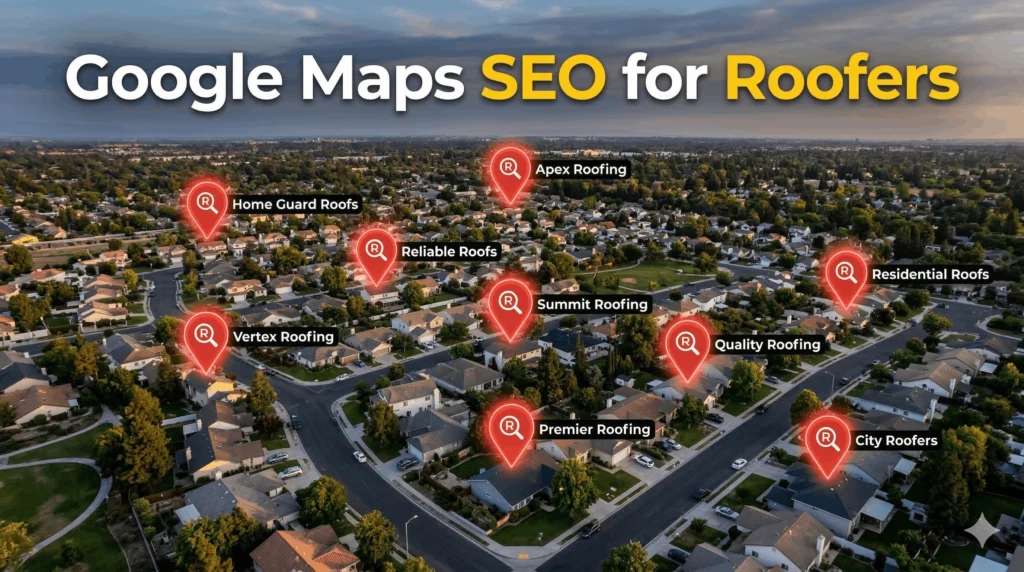
Google Maps SEO is the practice of optimizing a roofing company’s Google Business Profile and website so it ranks in the local map pack — the three businesses shown above organic results for “near me” searches, where most roofing calls originate.
How do roofing companies rank higher on Google Maps?
By strengthening the two controllable ranking factors: Prominence (reviews, citations, engagement) and Relevance (correct primary category, complete profile, local pages). Reviews — volume, recency, and responses — are the single biggest controllable lever for roofers.
Why is Google Maps important for roofing companies?
The map pack sits above organic results and captures urgent “near me” searches, often on mobile. Many homeowners call directly from the map result, so for most roofers it generates more leads than traditional organic rankings.
How long does it take to rank in Google Maps?
Most roofers see movement within 1–3 months of consistent optimization and stronger results by 3–6 months as reviews and citations build. Competition, profile completeness, and review velocity determine the pace.
What is the most important Google Maps ranking factor for roofers?
Among controllable factors, reviews (a Prominence signal) carry the most weight — considering volume, recency, and your responses. Distance matters too but is largely fixed, so reviews and relevance are where roofers should focus.
Do reviews really affect Google Maps rankings?
Yes — reviews are one of the strongest local ranking signals and a major conversion driver. Businesses with more recent, responded-to reviews consistently rank higher and earn more calls than those with few or stale reviews.

Saumya Patel is a Content Writer at Tarasaka Digital Solutions with over 4 years of experience creating SEO-focused content for businesses across multiple industries. Her areas of expertise include SEO, Local SEO, AI SEO, AEO (Answer Engine Optimization), GEO (Generative Engine Optimization), content strategy, and digital marketing.
At Tarasaka Digital Solutions, Saumya researches search trends, analyzes ranking factors, studies AI search behavior, and creates evidence-based content designed to help businesses improve online visibility, attract qualified leads, and build long-term organic growth. His content is developed using industry best practices, competitor analysis, and real-world search marketing insights to ensure accuracy, relevance, and practical value for readers.
Roofing SEO Florida, USA The Florida Roofing Monopoly: Why 3 Companies Control 82% of Google Maps (And The Visibility Engineering™ Fix) Book a Free Strategy

Healthcare SEO Cost How Much Does Healthcare SEO Cost in India? Book a Free Strategy Call See Case Studies Healthcare SEO in India 2026: Pricing,

SEO Services Ahmedabad SEO Services in Ahmedabad 2027: Pricing, Strategies, Results & What to Expect Book a Free Strategy Call See Case Studies SEO Services