
Blog
Why 3 Companies Control 82% of Google Maps (And The Visibility Engineering™ Fix)
Roofing SEO Florida, USA The Florida Roofing Monopoly: Why 3 Companies Control 82% of Google Maps (And The Visibility Engineering™ Fix) Book a Free Strategy

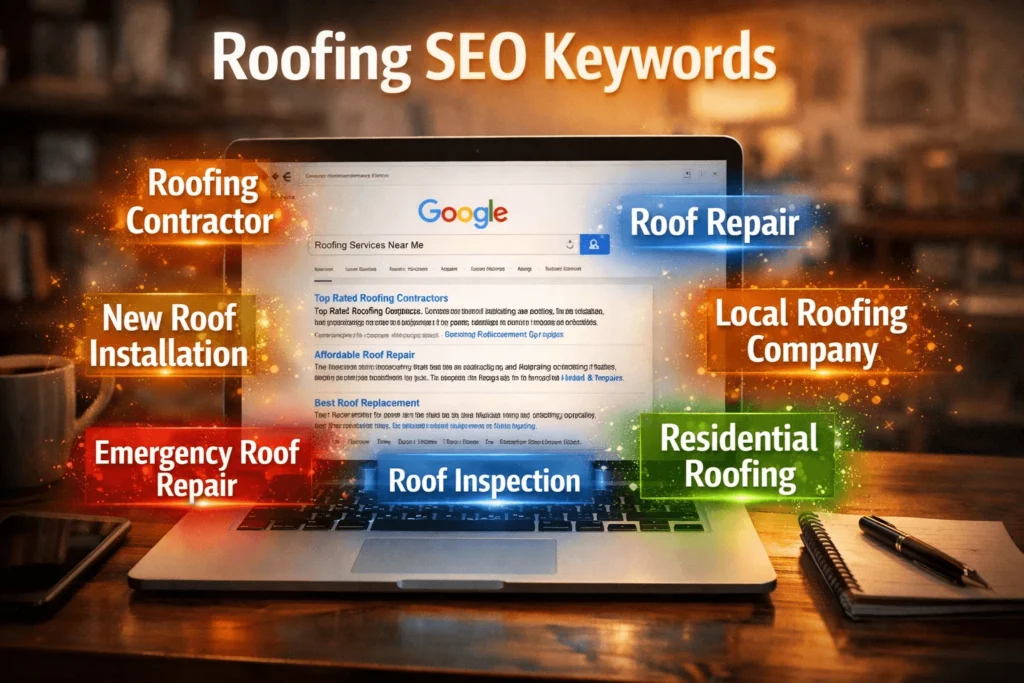
Which Ones Actually Book Jobs (and How to Map Them)
By Saumya Patel | Content Writer | 4+ Years of Industry Experience | Last Updated: June 12, 2026 | ~15 min read
The best roofing SEO keywords aren’t the highest-traffic ones — they’re the ones that book jobs. Prioritize high-intent, local terms (“roof repair near me,” “[city] roofing contractor”), then emergency and commercial terms by job value, and use informational keywords to build authority and earn AI citations. A keyword list is worthless until each term is mapped to the right page.
Every roofing SEO article gives you a list of 50 keywords. None tell you which ones to chase first, what each is worth, or which page should target them — so the list sits in a spreadsheet and nothing ranks.
This guide fixes that with a proprietary scoring model — the Keyword Value Map — and a keyword-to-page system you can deploy this week. For the full picture, see our roofing SEO services guide.
First principles: a keyword is only valuable if a homeowner who searches it is likely to hire, and if you have the right page to answer it. Traffic volume is a vanity metric — “how long does a roof last” gets searched constantly but rarely books a job, while “emergency roof repair near me” is searched less but converts immediately. Chasing volume over intent is the most common, most expensive keyword mistake roofers make.
Don’t ask “which keywords get the most searches?” Ask “which keywords book jobs, and which page should own each one?” Intent and mapping beat volume every time.
Score every roofing keyword on two axes — buyer intent and job value — then prioritize by where they land. This turns a flat list into a ranked, strategic plan:
| Tier | Keyword Type / Examples | Intent | Priority |
|---|---|---|---|
| Tier A | “roof repair near me,” “emergency roof repair,” “[city] roofing contractor” | Ready to hire | Highest — Win First |
| Tier B | “commercial roofing contractor,” “roof replacement company” | Ready, high ticket | High |
| Tier C | “roof replacement cost,” “metal vs shingle roof” | Comparing, near decision | Medium-High (AI Overviews) |
| Tier D | “how long does a roof last,” “signs you need a new roof” | Researching | Support — Trust & Citations |
The operational rule: win Tier A and B first (they sign immediate jobs), use Tier C to capture researching buyers, and publish Tier D to build topical authority and earn conversational AI citations. Most roofers invert this stack and wonder why their traffic doesn’t convert.
These signals indicate a ready-to-hire homeowner: “roof repair near me,” “roofing contractor near me,” “roof replacement company,” and “roofing services near me.” They belong explicitly on your core service pages and your Google Business Profile because they are the transactional searches that ring your office phone.
Phrases like “roofing contractor Tampa,” “roof repair Miami,” and “roofing company Orlando” carry hyper-local intent. They are the highest-converting roofing searches and are the most likely to surface the Google Map Pack. Each city you serve needs its own genuinely unique page — not a cloned page with the city name swapped, which Google flags as thin or duplicate content.
Terms like “emergency roof repair near me,” “storm damage roof repair,” “roof leak repair,” and “hail damage roof repair” spike aggressively after severe weather events and convert rapidly. Pair dedicated landing pages with Local Services Ads to capture these localized surges while they last.
Searches like “commercial roofing contractor,” “industrial roofing services,” and “flat commercial roofing” have lower search volume but far higher overall contract value. They are well worth dedicated landing assets even at modest numbers because a single signed contract can outweigh dozens of residential repairs.
Phrases like “metal roofing installation,” “tile roof replacement,” “roof replacement cost,” and “roof replacement estimate” capture buyers actively comparing options. Cost keywords are highly effective at feeding AI Overviews; answering them with clear, honest local ranges allows you to earn trust and search citations.
Topics like “how long does a roof last,” “signs you need roof replacement,” “roof maintenance tips,” and “roof inspection checklist” present lower direct lead conversion but high long-term authority value. Structuring this content as clear question-and-answer blocks helps win featured snippets and AI engine citations to build brand trust early in the consumer research phase.
How should roofing companies use SEO keywords?
Direct answer: Map each keyword to one dedicated page that matches its intent — don’t spread keywords randomly across the site. Tier A service and local keywords go on service and city pages; commercial keywords get their own pages; cost and material keywords go on comparison pages; informational keywords go in blog guides. One primary keyword per page, used naturally in the title, H1, and content.
| Keyword Type | Where It Lives (Target Architecture) |
|---|---|
| High-Intent Service | Core Service Landing Pages (e.g., Roof Repair, Roof Replacement) |
| Local Keywords | Dedicated City Pages (One unique page per targeted service area) |
| Emergency Keywords | Emergency / Storm-Damage Pages + Local Services Ads (LSA) |
| Commercial Keywords | Standalone Commercial Roofing Hubs & Industrial Asset Subpages |
| Material / Cost Keywords | Comparison Matrices and Cost Calculator / Estimator Guides |
| Informational Keywords | Blog Articles, In-Depth Consumer Resources, and Structured FAQ Sections |
The underlying structural principle: one page, one primary keyword, one search intent. Web pages that attempt to rank for everything end up ranking for nothing. This strict mapping protocol is exactly what separates a random list of keywords from an actionable content deployment plan.
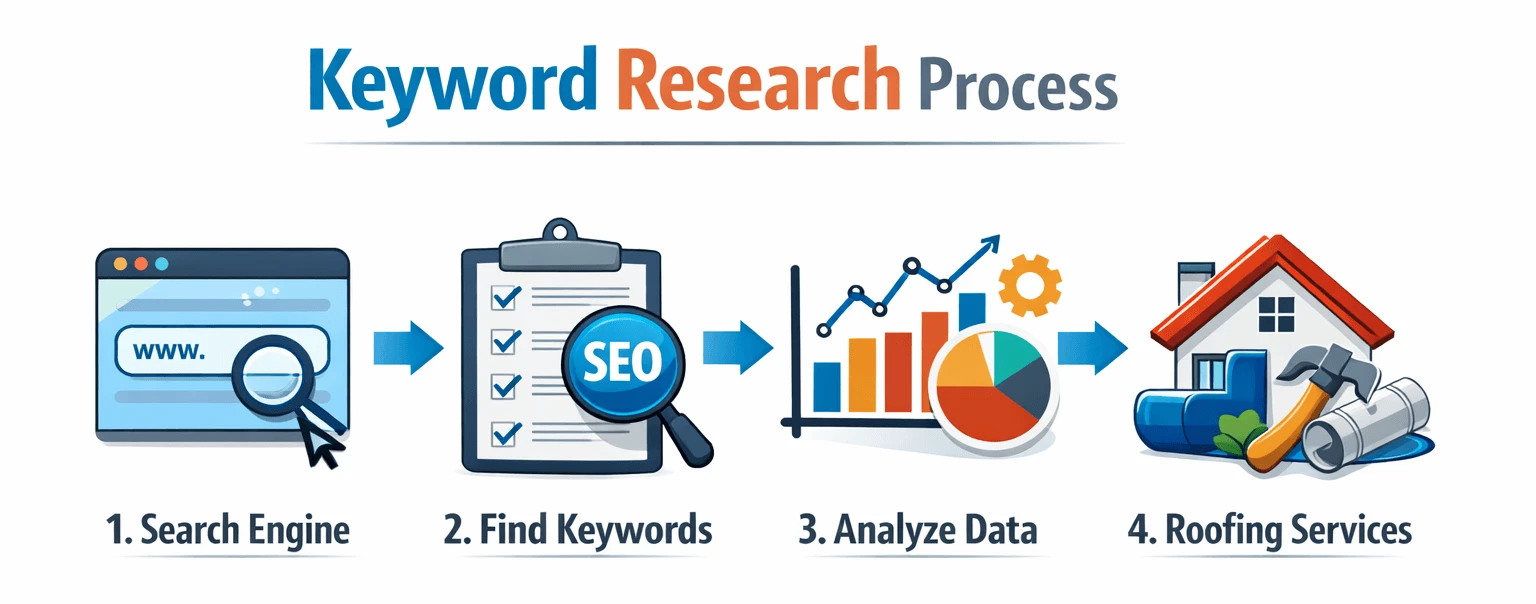
Once a specific keyword is assigned to its target page, integrate it naturally where it clearly signals relevance to search algorithms:
Keyword stuffing causes formatting and algorithm penalties. Focus heavily on clear language and clean search intent match; clarity will beat brute repetition every time.
How many keywords should a roofing website target?
Direct answer: There’s no fixed number — target one primary keyword per page, plus a handful of natural variations. A typical roofing site covers its core services, each service-area city, and a library of informational topics. Quality and intent match matter far more than how many keywords you list; one well-mapped page beats ten keyword-stuffed ones.
Instead of an unorganized spreadsheet, target these top 50 industry keywords sorted entirely by intent. Start your campaign optimization from the top tier:
roof repair near me · roofing contractor near me · roofing company near me · roofing services near me · roof leak repair near me · emergency roof repair · roof repair Tampa · roof repair Miami · roof repair Orlando · roofing contractor Florida · local roofing company · best roofing contractor near me · roof repair services near me · roof inspection near me
roof replacement company · roof replacement services · roof replacement contractors · roof replacement specialists · commercial roofing contractor · commercial roof repair · industrial roofing contractor · residential roofing contractors · roofing installation company
roof repair cost · roof replacement estimate · roof repair estimate · roof replacement Florida · metal roofing installation · tile roof repair · flat roof repair · flat roof maintenance · affordable roofing company · roof repair consultation
storm damage roof repair · roof storm damage repair · storm damage roofing contractor · hail damage roof repair · roof damage repair
roof inspection checklist · roofing maintenance tips · roof maintenance services · roof inspection services · signs you need roof replacement · how long does a roof last · roofing repair experts · roofing repair professionals · roof repair specialists · roof replacement experts · roof repair solutions · best roofing company
Roofing SEO keywords are not a passive list to collect; they form a strategic deployment roadmap. Score every target term using the Keyword Value Map framework, secure your local book-now clusters first, map each target keyword phrase strictly to one dedicated page, and use authoritative resources to win modern conversational AI citations.
Stop chasing raw, empty search volume metrics. Prioritize the specific keywords that fill booking schedules, give each term an optimized page home, and watch your local organic rankings and incoming service calls follow.

Roofing SEO Florida, USA The Florida Roofing Monopoly: Why 3 Companies Control 82% of Google Maps (And The Visibility Engineering™ Fix) Book a Free Strategy

Healthcare SEO Cost How Much Does Healthcare SEO Cost in India? Book a Free Strategy Call See Case Studies Healthcare SEO in India 2026: Pricing,

SEO Services Ahmedabad SEO Services in Ahmedabad 2027: Pricing, Strategies, Results & What to Expect Book a Free Strategy Call See Case Studies SEO Services