Tarasaka – Digital Solutions

We now offer Free AI Visibility Audits. find out if ChatGPT, Perplexity & Google AI can find your business. Claim yours →

Why Most Roofing Company Websites Don’t Generate Leads (And What Actually Fixes It)

Roofing website traffic without lead conversions illustration

Why Your Roofing Website Isn’t Generating Leads (and the 4 Fixes That Change It)

By Saumya Patel | Content Writer | 4+ Years of Industry Experience | Last Updated: June 12, 2026 | 14 min read

Quick Summary

Most roofing websites don’t generate leads because they were built to look professional, not to convert. A homeowner must grasp three things in five seconds: do you serve my area, do you solve my exact problem, and what do I do next? Fix homepage clarity, one strong service page, trust signals near action points, and a single clear next step — and existing traffic starts converting without spending a dollar more on ads.

You’ve invested in a website. You might even rank for a few keywords. But the phone barely rings, forms don’t convert, and every month feels like starting over from zero.

This isn’t rare — it’s the default state for the industry. And here’s the part almost no digital competitor quantifies: conversion is the only lever that improves every marketing channel at once. Double your website’s conversion rate and you instantly cut your cost per booked job in half across SEO, paid ads, and referrals simultaneously. Traffic without action is just an expensive vanity metric.


The Math Nobody Shows You

Why does website conversion matter more than just getting more traffic?

Direct answer: Because conversion multiplies every channel at once. If 1,000 visitors convert at 2%, you get 20 leads. Lift that to 4% and you get 40 leads from the exact same traffic — no extra ad spend, no new rankings required. Doubling conversion effectively halves your cost per booked job across every marketing channel simultaneously.

ScenarioMonthly VisitorsConversion RateLeads / MoCost Per Lead (at $2k spend)
Today1,0002%20$100
After Fixes1,0004%40$50

Same exact traffic. Same exact budget. Double the active lead volume. This is why chasing more clicks before repairing your baseline conversion funnel is the single most expensive mistake in field marketing — and why user conversion sits squarely at the top of the system in our comprehensive roofing marketing strategy guide.


The Real Reasons Roofing Websites Don’t Convert

After audit reviews of dozens of commercial and residential roofing sites across the country, the pattern is remarkably consistent — and it is rarely a pure traffic problem:
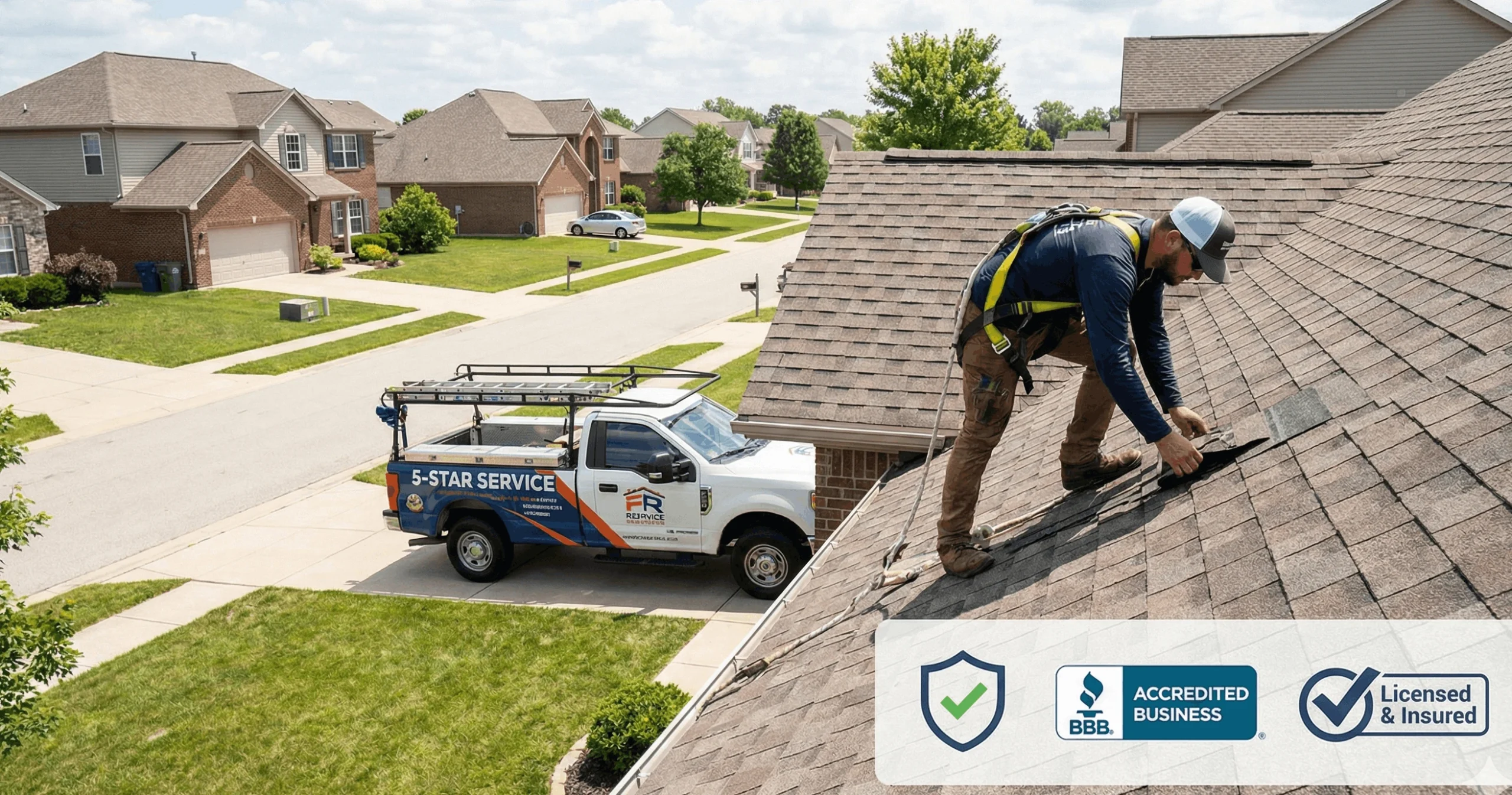
  1. The site is designed to look professional, not to convert: Clean layouts, massive generic stock photography hero images, and standard promises look nice, but provide no clear reason for a homeowner to act immediately. Most websites fail the baseline test below, forcing users to hunt for information until they abandon the tab.
  2. Messaging is written for Google bots, not homeowners: Pages stuffed with heavy search phrases say nothing valuable to the end user. Homeowners aren’t looking to read about “world-class building solutions”—they are stressed about roof leaks, insurance timelines, wind damage, and contractor trust. Copy optimized purely for search algorithms is an error we break down in roofing SEO mistakes.

    Local roofing contractor working in residential neighborhood 1 1 e1768753925967 scaled

  3. There is no visible local trust: Missing real team photos, ambiguous coverage lines, and absent local landmarks fail to show you operate in the visitor’s immediate neighborhood. In home services, trust verification must happen before sales conversion. This matches the signal-agreement challenge featured in local SEO for roofing companies.

SEO Isn’t Broken — the Website Experience Is

This is where contractors get misled. You might win the ranking and secure the initial click, but modern search algorithms evaluate user engagement and structural helpfulness, not just keywords. If users land on your site, hesitate, scroll aimlessly, and bounce back to search, your traffic asset becomes a cost.

The principle: SEO brings qualified prospects to your front door. Your website layout must finish the job.


The 5-Second Test (Tarasaka Framework)

Open your current homepage and give a stranger exactly five seconds to review it. They must be able to confidently answer all three of these foundational questions — if they miss even one, your site has a costly conversion leak:

The Core QuestionWhat Proves It On-PageWhere It Must Appear
1. Do you serve my area?Your primary city or exact regional service areas named in plain text.Main headline or explicit subhead, clearly above the fold.
2. Do you solve my exact problem?Explicitly named services — such as leak repair, storm damage restoration, or complete replacement.Hero section body copy or immediate high-level menu links.
3. What do I do next?One single, unmistakable path of action — like a click-to-call link or a streamlined assessment form.Sticky navigation header, prominent hero buttons, and repeated across sections.

What Actually Converts Roofing Visitors Into Leads

  • Unmistakable Regional Relevance: State where you operate without burying the text. Homeowners should immediately see their municipality or county noted near the top of the interface layout.
  • Proof Placed at Conversion Milestones: Customer reviews hidden away on an isolated testimonials tab do not influence new traffic. Trust assets belong directly next to conversion points, scheduling buttons, and text fields. Trust delayed is trust denied. Reviews also drive map signals — see Google Maps SEO for roofers.
  • Structure Aligned with Intent: A high-converting layout answers prospect questions in the natural chronological order they think them: Is this provider capable of fixing my specific issue? Can I verify their local reputation? What is the exact sequence of events if I request an inspection?
  • Flawless Mobile Navigation: Most emergency and local residential roofing searches happen on mobile devices. If your mobile layout is sluggish, layout-shifted, or clunky, prospects will click out before your site finishes rendering.

How This Plays Out Locally

Search queries across diverse markets like Austin, Miami, San Diego, or Chicago will deploy distinct regional terminology, but the underlying psychology is identical. Clients demand proximity, immediate performance reassurance, and an obvious structural next step. Geographic page tailoring should support clean communication, not smother it. A Miami landing page detailing wind mitigation or hurricane prep, or a Chicago resource addressing structural ice dams, converts visitors because it proves specific real-world expertise rather than just repeating a target zip code.

Common Roofing Website Mistakes

  • Cramming vastly different service categories onto a single unorganized page.
  • Relying on generic stock photos instead of high-resolution images of your completed project sites.
  • Failing to include a clear reason or incentive for the homeowner to reach out today.
  • Building intake forms that demand too many intrusive, unnecessary details upfront.
  • Writing calls to action that read like high-pressure sales pitches instead of helpful solutions.
  • Isolating third-party trust logos, credentials, and verification links on secondary pages.


Roofing website conversion checklist illustration 1 1 e1768753715339

What to Fix First (In Order)

What should I fix first if my roofing website isn’t converting?

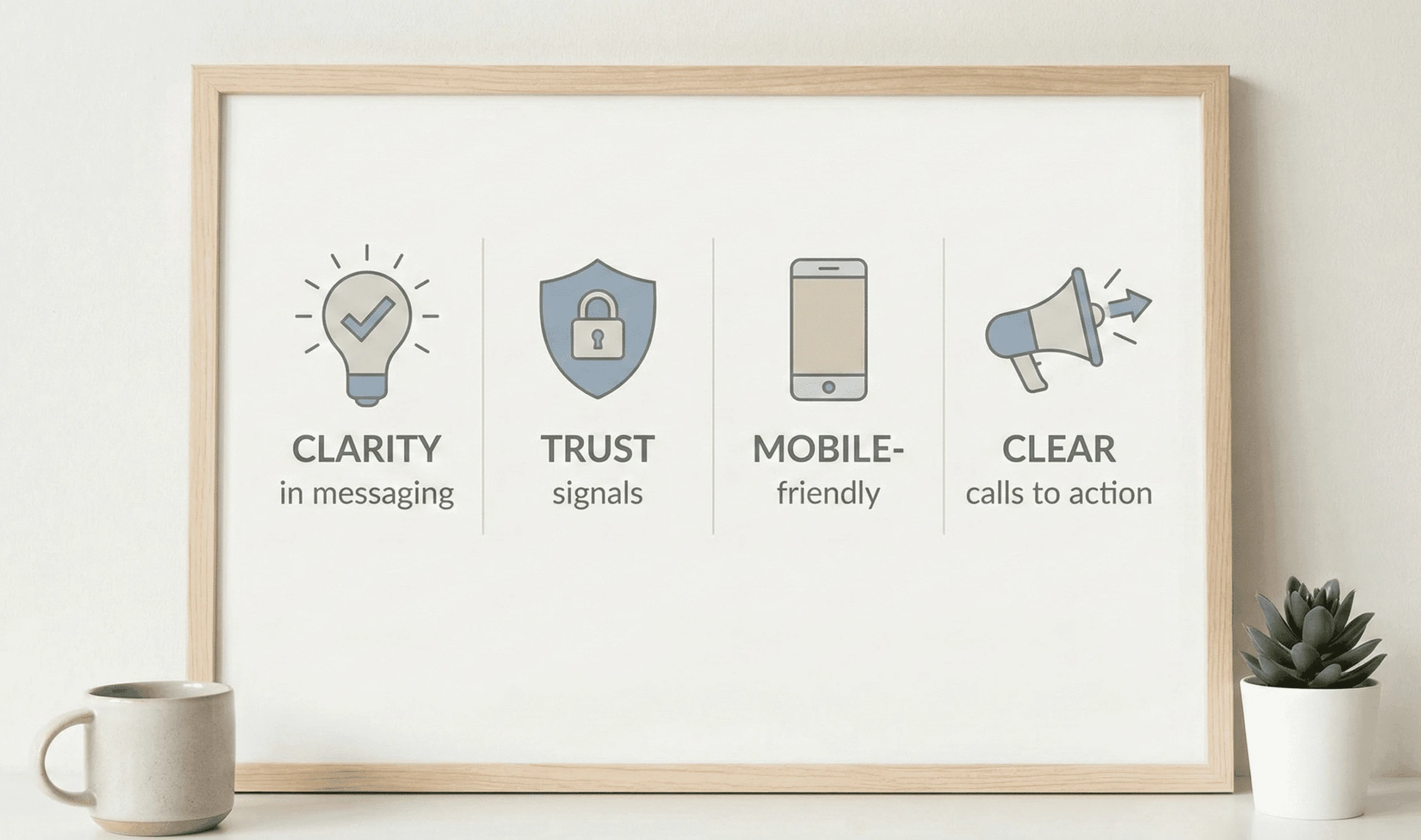
Direct answer: Fix in this order: (1) homepage clarity — make your service area and core offer unmistakable, (2) one strong service page rather than ten average ones, (3) trust signals placed near action points, and (4) one clear next step. These four changes create immediate momentum without needing a complete technical rebuild.

  1. Homepage Clarity: Ensure your core geographic service footprint and value statement are unmistakable within a 5-second glance.
  2. One High-Authority Service Page: Focus your energy on engineering one highly comprehensive, structural treatment page that answers every potential client concern, rather than spreading value thin across ten weak stubs.
  3. Trust Proximity: Move certified badges, local reviews, and license references right next to interactive phone links and inquiry modules.
  4. A Single, Obvious Call to Action: Clearly tell the user the precise step to take (e.g., call directly or drop a form submission) without overwhelming them with choices.

Deploy these adjustments sequentially to systematically capture incoming demand. For a wider perspective on search dominance, pair these conversion tactics with our roofing SEO checklist and comprehensive guide to roofing lead generation.


Objections and Misconceptions

  • “Our contracting business simply needs more raw traffic numbers.” Directing more traffic into a leaky digital bucket only compounds your acquisition losses. Focus on conversion layout fixes first — it optimizes the return across every single inbound marketing investment.
  • “We need to budget for a complete web system overhaul and brand redesign.” Rarely. Making two or three targeted adjustments — enhancing copy clarity, relocating proof elements, and cleaning up a single CTA path — will shift your lead generation metrics without an expensive development overhaul.
  • “Does search visibility or conversion layout matter more?” Neither can win without the other. SEO brings a motivated user to your landing page; layout conversion wraps up the transaction. A highly ranked search page that fails to inspire action is simply an overhead cost.

The Bottom Line

Most roofing businesses do not suffer from an under-performing traffic pool. They suffer because they fail to make their current traffic pool work hard enough. When your digital interface directly confirms your service footprint, surfaces verified evidence right where users make choices, and outlines an easy route to get started, passive browsers turn into active pipeline leads.

Securing the keyword rank is only half the battle. Organic optimization gets them to the asset — your layout has to seal the contract.

Not sure where your site is losing leads?

A simple audit reveals your conversion blockages quickly. Request a free conversion and local SEO audit from Tarasaka.


Explore Our Roofing SEO Services →

Because ranking brings visitors, not trust. Conversion depends on clarity, local relevance, and proof. If a homeowner can’t tell in five seconds that you serve their area, solve their problem, and what to do next, they leave — no matter how well you rank.

Yes. Most roofing searches are local and urgent, so proximity, Google Business Profile, and reviews decide who gets seen. But local SEO only delivers leads if the website then converts — visibility and conversion have to work together.

Usually optimization. A full rebuild is rarely necessary — fixing homepage clarity, one strong service page, trust placement, and a single clear call to action typically moves lead flow without redesigning the site.

Conversion fixes can show results within weeks, because you’re improving how existing traffic behaves rather than waiting for new rankings. SEO gains take 3–6 months; conversion gains are the fastest lever you have.

Neither works alone. SEO brings the visitor; the website converts them. A page that ranks but doesn’t convert is a cost, and a great site nobody finds earns nothing. Conversion is the higher-leverage fix because it improves every channel at once.

Substantially. Lifting conversion from 2% to 4% doubles leads from identical traffic — effectively halving your cost per lead across SEO, ads, and referrals simultaneously, with no extra spend.

Picture of  Saumya Patel

Saumya Patel

Saumya Patel is a Content Writer at Tarasaka with over 4 years of experience creating SEO-focused content for businesses across multiple industries. Her areas of expertise include SEO, Local SEO, AI SEO, AEO (Answer Engine Optimization), GEO (Generative Engine Optimization), content strategy, and digital marketing.

At Tarasaka, Saumya researches search trends, analyzes ranking factors, studies AI search behavior, and creates evidence-based content designed to help businesses improve online visibility, attract qualified leads, and build long-term organic growth. His content is developed using industry best practices, competitor analysis, and real-world search marketing insights to ensure accuracy, relevance, and practical value for readers.

Facebook
X
LinkedIn
WhatsApp

Ready to Dominate Local Search for Your Brand?

Book a free 30-minute audit — we'll show you exactly where visibility is being lost and how to win it back.