Blog
Why 3 Companies Control 82% of Google Maps (And The Visibility Engineering™ Fix)
Roofing SEO Florida, USA The Florida Roofing Monopoly: Why 3 Companies Control 82% of Google Maps (And The Visibility Engineering™
We now offer Free AI Visibility Audits. Find out if ChatGPT, Perplexity & Google AI can find your business. Claim yours →
Can local businesses appear in Google AI Overviews?
Yes — most often on informational and research queries (cost, comparisons, “best” lists), not on “near me” searches, which still show the Local Pack. To be cited, structure content as clear question-and-answer blocks with tables and lists, backed by schema and genuine expertise.
Do AI Overviews affect “near me” searches?
Barely. Local-intent queries like “near me” or “[city] + service” trigger the Local Pack instead of an AI Overview — only a 4–8% overlap (BrightLocal 2026). For transactional local demand, your Google Business Profile and reviews still matter most.
GEO (Generative Engine Optimization) structures your content and entity data so AI systems — Google AI Overviews, ChatGPT, Gemini, Perplexity — can identify, trust, and cite you. It extends SEO from ranking pages to being named inside AI-generated answers.
Does local SEO still matter in 2026?
More than ever. “Near me” queries still surface the Local Pack, and an optimized Google Business Profile, reviews, and NAP consistency remain the top local ranking factors. AI adds new surfaces; it doesn’t replace local SEO.
What content gets cited by AI?
Scannable, structured content. AirOps (2026) found comparison pages with three tables earn ~25.7% more citations, validation pages with eight list sections up to ~26.9% more, and pages averaging ≤10 words per sentence ~18.8% more. Tables, lists, and short sentences win.
What's the best marketing strategy for law firms in 2026?
A sequenced mix: PPC for speed, SEO for compounding low-cost leads, and GEO to stay visible inside AI-generated answers. The exact ratio depends on your timeline, case value, and budget stability.
What Actually Wins AI Visibility
By Saumya Patel | Content Writer | 4+ Years of Industry Experience | Last Updated: June 10, 2026 | 16 Min Read
INTRODUCTION
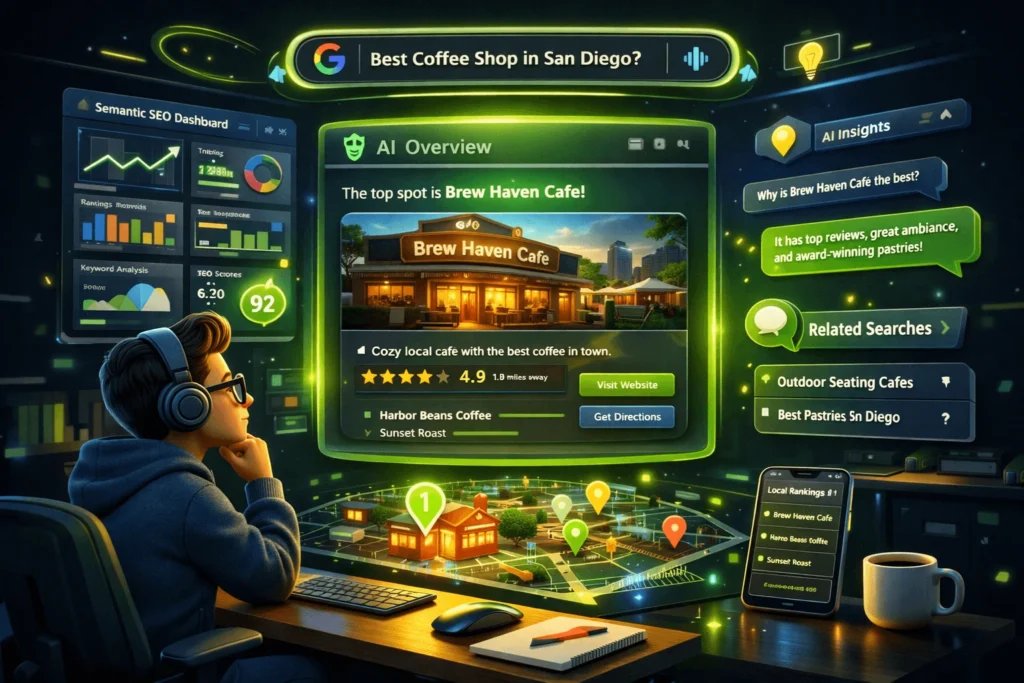
Google AI Overview SEO is the practice of structuring your business’s content and entity data so AI systems cite you in their answers. But here’s what most guides get wrong: “near me” searches barely trigger AI Overviews — they still show the Local Pack. The real shift for local businesses is happening on three separate surfaces — the Map Pack, the AI Overview, and AI Assistants like ChatGPT — and each is won differently. Optimizing for the wrong surface wastes budget.
Almost every article on this topic tells local businesses the same thing: AI Overviews are eating your traffic, so optimize for them or disappear. That advice is half-right and dangerously imprecise. It sends a plumber chasing AI Overview citations for “emergency plumber near me” — a query that almost never shows an AI Overview.
This guide fixes that with current 2026 data and a proprietary model — the Local AI Visibility Triangle — that tells you exactly which surface to win, and how.
Start with the single most important — and most ignored — fact in local AI search: Local-intent queries like “near me” or “[city] + service” trigger the Local Pack, not an AI Overview, with only a 4–8% overlap (BrightLocal 2026). Local service providers and e-commerce are relatively sheltered; informational and educational queries are hit hardest.
Why this matters: If your demand is mostly transactional and local, AI Overviews are a minor threat — your battle is still the Map Pack. If buyers research before they call (“how much does Invisalign cost,” “best roofer for flat roofs”), AI surfaces matter enormously. Knowing which one you are decides where every dollar goes.
Meanwhile, the broader shift is real: AI Overviews now appear on roughly 48% of all tracked queries as of February 2026, up from 31% a year earlier (BrightEdge), and around 64.8% of Google searches now end without a click. The lesson isn’t “panic” — it’s “aim correctly.”
What are Google AI Overviews?
Google AI Overviews are AI-generated answers shown at the top of search results. Instead of only listing websites, Google synthesizes information from multiple trusted sources into a direct answer and cites some of them. They appear most on informational and research queries — and least on local “near me” searches, which still surface the Local Pack.
The economics underneath are stark. On queries where an AI Overview appears, organic click-through rates fell about 61% in 2025 (Seer Interactive), before partly recovering to ~2.4% by February 2026. But brands cited inside the Overview earn roughly 120% more clicks per impression than uncited brands on the same query. Citation, not just ranking, is now the prize.
Stop optimizing for “AI search” as one thing. Local visibility in 2026 lives on three distinct surfaces, each triggered by different queries and won by different signals:
| Surface | Triggers On | What Wins It |
|---|---|---|
| 1. The Map Pack | “near me,” “[city] + service,” emergency, transactional | Google Business Profile, reviews, proximity, NAP consistency, citations |
| 2. The Overview | “how much does X cost,” “best X for Y,” research | Entity authority, schema, citable structured content, E-E-A-T |
| 3. The Assistant | Off-Google research in ChatGPT, Gemini, Perplexity | Brand mentions, consistent entity data, third-party citations |
The principle: The Map Pack wins you the ready-to-buy local searcher, the Overview wins you the researcher, and the Assistant wins you the buyer who never opened Google at all. Most local businesses need all three — weighted by their query mix.
For transactional local demand, nothing changed as much as the headlines suggest. The Local Pack still owns “near me.” Win it with a complete, correctly categorized Google Business Profile, a steady flow of recent reviews with responses, consistent NAP (name, address, phone) across the web, and citations on trusted directories. Proximity and relevance still rule here — not AI.
This is where AI genuinely reshapes discovery. When a prospect researches before buying — cost, comparisons, “best” lists — Google answers with an Overview and cites a few sources. To be one of them, your content must be structured for extraction: clear question-based headings, a concise direct answer up top, then supporting depth, backed by schema and real expertise.
A growing share of buyers now ask ChatGPT, Gemini, or Perplexity for recommendations — and there is no Local Pack there. These engines assemble answers from entity data and third-party mentions across the web. Note the scale of the behavior shift: in Google’s AI Mode, about 93% of searches end without a click, versus 43% for AI Overviews (Semrush). Winning here is about being a consistently described, frequently mentioned entity — not about ranking a page.
Why is AI search different from traditional SEO?
Traditional SEO matched keywords to pages. AI search matches meaning to entities. AI systems try to understand who you are, what you specialize in, where you operate, and whether you’re trusted — then assemble an answer. So the unit of optimization shifts from “the keyword on a page” to “the entity across the web.”
First principles: A language model can’t rank ten links — it must choose what to say. To say your business is the answer, it needs to be confident about your identity and authority. That confidence is built from consistent, corroborated signals: a clear entity (business, location, services), structured data that labels it, reviews and mentions that validate it, and content that demonstrates genuine expertise. Ambiguity is the enemy of citation.
Here’s a hard truth competitors skip: in the AI era, exposure no longer equals traffic. You can be cited in an AI Overview and get almost no click. That sounds like a loss — until you measure it correctly. Citations build branded awareness and trust, which show up later as branded search lift and higher conversion on the clicks you do get (cited brands earn ~120% more clicks per impression than uncited ones).
The strategic shift: Stop measuring only sessions. Start measuring share of AI citations, branded search volume, and assisted conversions. A business that’s named in the answer wins even when the user doesn’t click — because it becomes the option they remember and search for by name.
This is now measurable, not theoretical. Structural choices materially change citation rates (AirOps, April 2026):
The takeaway: AI rewards scannable, structured, concise content — tables, lists, short sentences, and direct answers. Dense, meandering prose is invisible to retrieval. Format is now a ranking factor for AI.
Ten moves, mapped to the surface they actually influence so you don’t waste effort:
Match your dominant query type to your priority surface:
| If most demand is… | Business Examples | Prioritize |
|---|---|---|
| Emergency / transactional local | Plumber, locksmith, towing, emergency dentist | Map Pack — AI Overviews are a minor concern |
| Researched, considered purchase | Cosmetic dentist, roofer, law firm, med spa | Overview + Assistant — GEO content is critical |
| Mixed | Most local service businesses | All three, weighted to your top queries |
Google AI Overview SEO matters — but precision matters more. For local businesses, the win isn’t blindly “optimizing for AI.” It’s knowing which of the three surfaces your customers actually use, then dominating it: the Map Pack for ready-to-buy locals, the Overview for researchers, and the Assistant for the buyers who skip Google entirely.
The businesses that win in 2026 stop treating AI search as one monster to fear and start treating it as three doors to walk through — each opened with a different key.
Get a free AI Search Visibility Audit from Tarasaka and a surface-by-surface action plan.
Request your audit →
Editorial Note: This article is based on research from industry publications, official platform documentation, and publicly available data. Information is current as of the publication date and may change as search engines, AI platforms, and advertising systems evolve.
Saumya Patel is a Content Writer at Tarasaka Digital Solutions with over 4 years of experience creating SEO-focused content for businesses across multiple industries. Her areas of expertise include SEO, Local SEO, AI SEO, AEO (Answer Engine Optimization), GEO (Generative Engine Optimization), content strategy, and digital marketing.
At Tarasaka Digital Solutions, Saumya researches search trends, analyzes ranking factors, studies AI search behavior, and creates evidence-based content designed to help businesses improve online visibility, attract qualified leads, and build long-term organic growth. His content is developed using industry best practices, competitor analysis, and real-world search marketing insights to ensure accuracy, relevance, and practical value for readers.
Roofing SEO Florida, USA The Florida Roofing Monopoly: Why 3 Companies Control 82% of Google Maps (And The Visibility Engineering™

Healthcare SEO Cost How Much Does Healthcare SEO Cost in India? Book a Free Strategy Call See Case Studies Healthcare

SEO Services Ahmedabad SEO Services in Ahmedabad 2027: Pricing, Strategies, Results & What to Expect Book a Free Strategy Call