

Blog
Why 3 Companies Control 82% of Google Maps (And The Visibility Engineering™ Fix)
Roofing SEO Florida, USA The Florida Roofing Monopoly: Why 3 Companies Control 82% of Google Maps (And The Visibility Engineering™ Fix) Book a Free Strategy

By Saumya Patel | Content Writer | 4+ Years of Industry Experience | · Updated 2026 · ~15 min read
“GPT-5” is no longer one model — since its August 2025 launch it has iterated through several generations (5.1, 5.3, 5.4, 5.5, and the current 5.6 family), with older versions like 5.1 already retired from ChatGPT. For small business use, the practical question isn’t ‘should we use GPT-5’ — it’s which access tier and model size fit a specific task: ChatGPT Plus/Team for most day-to-day work, the API with a smaller model for high-volume automation, and the top-tier model reserved for genuinely complex reasoning.
The GPT-5 series remains one of the fastest ways for U.S. small businesses to cut support time, ship on-brand marketing, and automate busywork — but the model landscape moves in 6–8 week cycles, and content that names a specific version as ‘the newest thing’ goes stale within a quarter.
This guide keeps the practical part evergreen — the use cases, guardrails, and 30-day pilot plan still work exactly as designed — while giving you the SMB AI Tier Fit Framework to figure out which access level and model size to use for any task, regardless of which specific version is current when you read this.
What’s the current GPT-5 model as of 2026?
Direct answer: The GPT-5 series has iterated multiple times since its August 2025 launch. By mid-2026, OpenAI had released GPT-5.1, 5.3, 5.4, 5.5, and the current GPT-5.6 family (Sol, Terra, and Luna tiers), reaching general availability July 9, 2026. Some earlier versions have already been retired from ChatGPT — GPT-5.1 in March 2026 and GPT-4.5 in June 2026 — so ‘GPT-5’ now functions more like a generation name than one fixed model. Always check OpenAI’s current model page before committing to a specific version in a workflow.
The underlying capabilities the original wave of GPT-5 coverage highlighted — stronger multi-step reasoning, more reliable instruction-following, and a unified system that decides when to answer instantly versus ‘think’ longer — have carried through and improved with each subsequent release, including expanded coding and agentic capabilities. The specific model name behind those capabilities keeps changing; the underlying advantage for SMBs hasn’t.
Better instruction-following and lower hallucination rates mean less fixing and more doing — in support, marketing, SEO, and day-to-day operations. The practical benefits SMBs care about:
Match the task to the tier — overpaying for the flagship model on simple tasks wastes budget; underpowering a complex task wastes time on fixes:
| Task type | Best fit | Why |
|---|---|---|
| Day-to-day drafting, support, SEO briefs | ChatGPT Plus or Team | Flat monthly cost, no token accounting, good for non-technical staff |
| High-volume, simple automation (tagging, summarizing) | API, smallest/cheapest model tier | Cost scales with volume — use the lightest model that reliably does the job |
| Complex reasoning, multi-step workflows, coding | API, flagship model tier | Worth the higher per-token cost when the task genuinely needs it |
| Team-wide use inside existing Microsoft tools | Microsoft Copilot (GPT-5-series powered) | No new tool to learn if the org already lives in M365 |
The principle: most SMB tasks don’t need the flagship model. Route simple, high-volume work to the cheapest model that handles it reliably, and reserve the top tier for the handful of tasks where reasoning quality actually changes the outcome — this is where most SMBs overspend without realizing it.
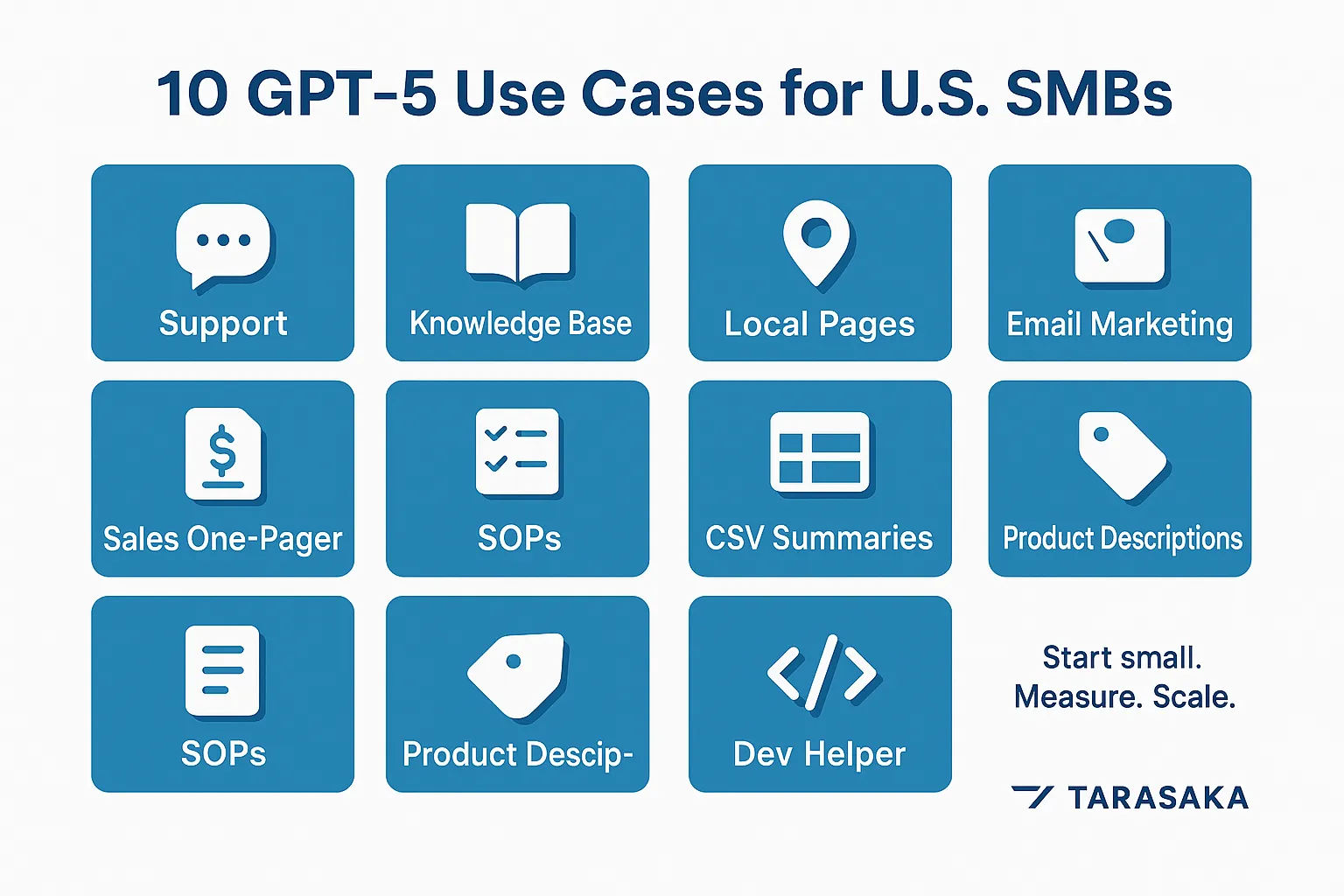
Use these as starting points — edit the bracketed parts with your specifics. These patterns work regardless of which specific model version is current.
Resolves common issues, refund rules, shipping status, and basic troubleshooting without sending everything to a human.
Prompt: “You are a policy-bound support assistant for [Brand]. Using this policy [paste brief policy or link], draft a helpful reply to this customer message [paste]. Keep it under 160 words. Offer one next step and one link to our help center.”
Converts messy internal docs into clean, FAQ-style articles that AEO/GEO can surface in AI search results.
Prompt: “Turn the notes below into a public FAQ. Use H2/H3 headings, bullets, and an ‘Action steps’ box. Include a 1-sentence summary up top. [paste notes]”
Research, outline, and schema suggestions for blog posts and local landing pages — see our guide on using ChatGPT for SEO for a deeper workflow.
Prompt: “Create a 2026 SEO brief for [topic] aimed at U.S. SMB owners. Include search intent, title tags, H2/H3s, FAQs for AEO, and recommended schema types.”
Drafts promos, nurture flows, and post-purchase follow-ups in your brand voice.
Prompt: “Write a 3-email sequence for [offer] in [brand voice: friendly, direct, witty]. Add subject lines and preview text (≤60 chars).”
Generates unique service/location pages with consistent structure and a clear CTA — pair with our local SEO strategies guide for what actually ranks.
Prompt: “Draft a local service page for [service] in [city, state]. Include a 140-char meta description, 2 customer quotes, and a 4-item FAQ.”
Creates one-pagers, ROI calculators, and objection handlers.
Prompt: “Summarize our value prop for [industry] in 150 words + 3 quantified benefits and 3 objection responses.”
Converts tribal knowledge into shareable standard procedures.
Prompt: “Turn these steps into an SOP with roles, tools, time estimates, and risks. [paste steps]”
Summarizes CSVs, flags anomalies, drafts status updates — a strong candidate for the cheapest API model tier given its repetitive, low-complexity nature.
Prompt: “Read this CSV [describe columns] and draft a weekly summary with 5 KPIs, 3 anomalies, and 2 recommendations.”
Produces unique, consistent catalog copy with rules for tone and compliance.
Prompt: “Write 5 variant descriptions for [product]. 90–120 words each, include 3 features, 2 benefits, and 1 care tip.”
Scaffolds scripts, integrations, and bug fixes for small web apps — current models in this series carry particularly strong coding and agentic-workflow capabilities.
Prompt: “I’m building [describe tool] with [stack]. Generate starter code + a README with setup steps and a security checklist.”
How much does GPT-5 cost for a small business?
Direct answer: Pricing depends entirely on access method and changes frequently as OpenAI updates model tiers. ChatGPT Plus runs a flat monthly fee per seat; Team and Enterprise plans scale from there. API access is metered per token, with a wide spread between the cheapest and flagship model tiers — output tokens typically cost several times more than input tokens. Because pricing has shifted multiple times within 2026 alone, check OpenAI’s current pricing page directly before budgeting rather than relying on a fixed figure from any article, including this one.
What’s stable enough to plan around: ChatGPT’s consumer and business plans are seat-based and separate from API billing; the API has no subscription, running on prepaid credits drawn down per token; and the gap between the cheapest and most capable model tier is usually large enough that routing simple tasks to a smaller model meaningfully changes your monthly cost.
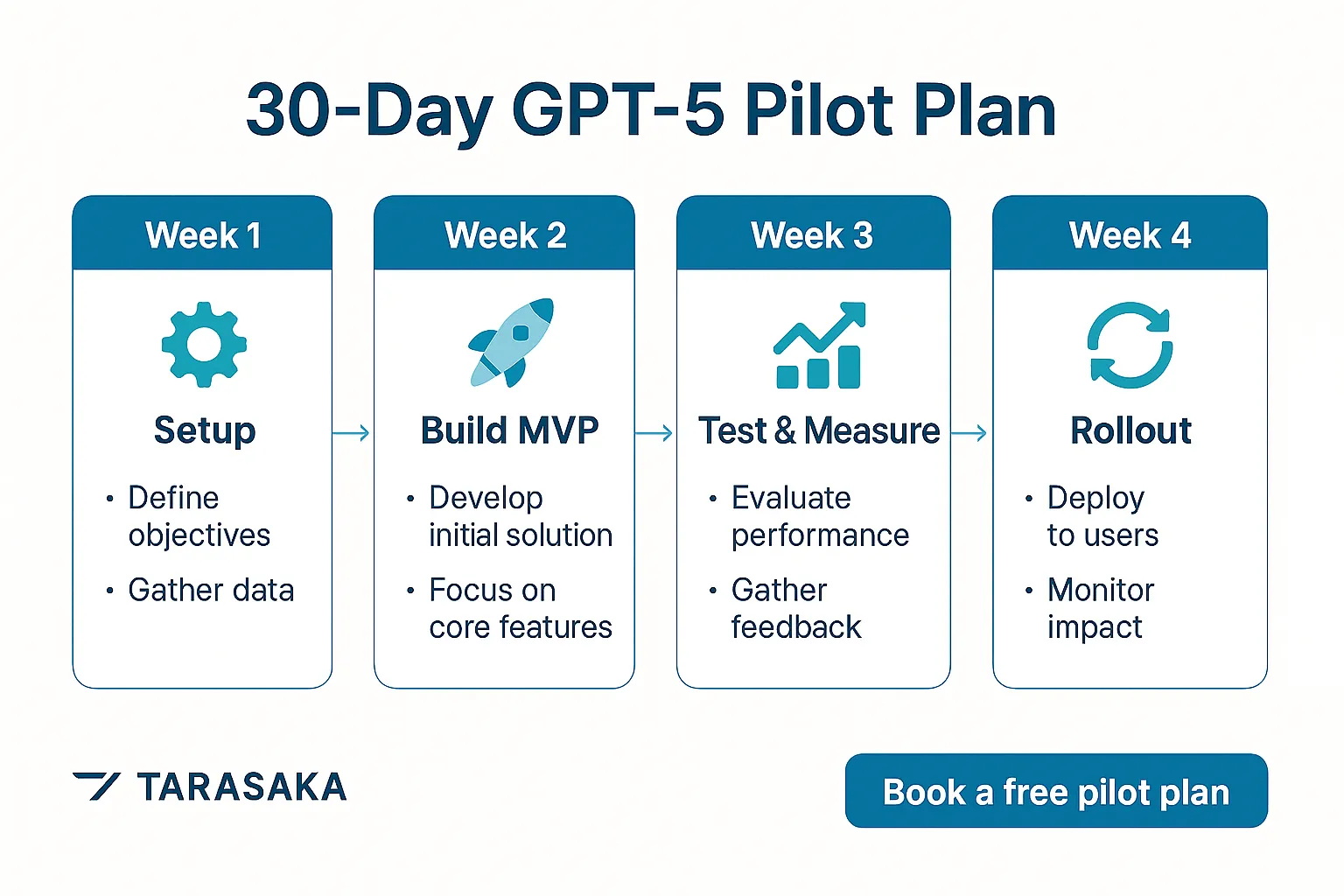
GPT-5 — or whichever specific version of it is current when you’re reading this — remains one of the fastest ways for U.S. small businesses to cut support time, ship on-brand marketing, and automate busywork. The smartest move is still to start small: pilot it in one or two workflows, measure the impact, and expand as you see ROI.
Route tasks to the right tier, keep humans in the loop on anything public-facing, and treat the specific model version as a detail to check periodically — not a fact to memorize once and forget. Explore our full range of digital marketing services in the USA to see how we integrate AI into scalable growth frameworks.
Let’s map it together and connect it to your existing marketing and SEO workflows.

Roofing SEO Florida, USA The Florida Roofing Monopoly: Why 3 Companies Control 82% of Google Maps (And The Visibility Engineering™ Fix) Book a Free Strategy

Healthcare SEO Cost How Much Does Healthcare SEO Cost in India? Book a Free Strategy Call See Case Studies Healthcare SEO in India 2026: Pricing,

SEO Services Ahmedabad SEO Services in Ahmedabad 2027: Pricing, Strategies, Results & What to Expect Book a Free Strategy Call See Case Studies SEO Services