Blog
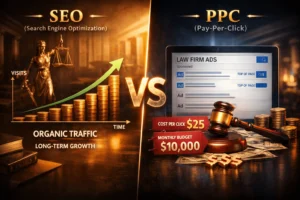
Law Firm SEO vs PPC: Which Generates More Legal Clients in 2026?
Law firm seo vs ppc Law Firm SEO vs PPC: Which Generates More Legal Clients in 2026 Book a Free Strategy Call See Case Studies
We now offer Free AI Visibility Audits. Find out if ChatGPT, Perplexity & Google AI can find your business. Claim yours →
By Saumya Patel | Content Writer | 4+ Years of Industry Experience | Updated 2026 · ~16 min read
Local SEO for small businesses isn’t one playbook applied evenly across every industry. A roofer, a law firm, a dental clinic, and a business coach all compete for local visibility differently — the top 3 Google Map Pack results capture the large majority of clicks, but which signal gets you there first depends on your business type. Home services live and die on review velocity and speed; law firms win on trust and citation authority; dental clinics face YMYL rules the others don’t; coaches often need local authority content more than a Map Pack listing at all.
Most local SEO guides for small businesses give every industry the identical five-tactic checklist — Google Business Profile, reviews, citations, city pages, tracking — as if a personal injury law firm and an emergency roofer compete for attention the same way. They don’t.
This guide keeps the five core tactics (they’re genuinely foundational — see our companion piece on Local SEO Strategies USA for how they’re weighted), but adds what’s missing: a Small Business Fit Matrix that tells you which tactic to prioritize first, based on what kind of business you actually run.
A large majority of local Google searches lead to a call or visit within a day, and the top 3 results in the Map Pack capture the majority of clicks — position four and below are effectively invisible. Meanwhile paid ad costs keep climbing (see our local SEO vs paid ads breakdown for the numbers), which makes owned local visibility more valuable, not less, every year. Yet most small businesses — law firms, dental clinics, home services — remain invisible in the Map Pack while spending money elsewhere.
Four common small-business categories, and what actually moves the needle first for each — because “do everything” isn’t a strategy when you have limited time and budget:
| Business type | Priority #1 | Priority #2 | Why it differs |
|---|---|---|---|
| Law firms | Citations + legal directory authority | Reviews (case-outcome framed carefully) | High-value, low-frequency decisions — trust and third-party authority matter more than review volume alone |
| Dental / healthcare | Google Business Profile completeness + YMYL-compliant content | Review recency | YMYL rules apply; clinical accuracy and HIPAA-aware tracking are non-negotiable, not optional add-ons |
| Home services / roofing | Review velocity + speed-to-lead | Service-area accuracy | Urgent, comparison-light decisions — whoever looks trustworthy and responds fastest wins the call |
| Coaches / consultants | Local authority content + personal brand signals | Google Business Profile (often secondary) | Often serve clients beyond one metro — local Map Pack matters less than credibility content and niche authority |
The principle: the five core tactics below are the toolbox, not the plan. A dental clinic that skips YMYL content review to chase review volume, or a coach who obsesses over Map Pack ranking instead of authority content, is optimizing for the wrong business model.
These apply to every business type above — the Fit Matrix tells you which to lean into hardest first, not which to skip.
Complete, accurate NAP (name, address, phone) details, services and service areas listed explicitly, and regular posts to avoid crossing the freshness threshold where impressions start declining. Set the primary category precisely — vague categorization is one of the most common, most fixable local SEO mistakes.
Review recency now matters more than raw count — a steady stream of fresh, responded-to reviews outperforms a large stockpile with nothing new in months. Encourage photo and video reviews where appropriate, and resolve negative feedback professionally and publicly rather than ignoring it. Avoid keyword-stuffing responses; specific, natural replies build more trust and carry less policy risk.
List your business on Yelp, Angi, industry-specific directories, and healthcare or legal directories where relevant. Consistency across every listing matters more than sheer volume — mismatched NAP details actively undermine the trust you’re trying to build.
Genuinely distinct pages per service area — Dental SEO in Houston or Web Design Agency in Denver — optimized with local keywords and real local FAQs, not a template with the city swapped. Duplicated pages read as thin content to both users and Google.
Track Map Pack position, calls, and booked business — not just traffic — using Google Analytics, a rank tracker, and call tracking. Rankings are a leading indicator; booked revenue is what confirms the strategy is actually working.
How long until I see local SEO results?
Direct answer: Most small businesses see noticeable Map Pack movement within 6–12 weeks of consistent, correctly-prioritized work, with stronger gains by 3–6 months depending on local competition and review velocity. Businesses that follow the Fit Matrix — focusing on their highest-leverage tactic first — typically move faster than those spreading effort evenly across all five tactics from day one.
This matters enough to say directly, and it applies as much to us as to anyone: if an agency promises a specific multiple of leads within a fixed number of days — ‘triple your leads in 90 days’ is a common version — treat it the way you’d treat any ranking guarantee. No one controls Google’s algorithm or your local competition closely enough to promise a specific outcome on a specific date. Ask instead for a realistic range, tied to your starting point and market, and judge an agency on transparency and process rather than the size of the number they promise.
Local SEO for small businesses is a growth system, not a one-time task — but it’s not a single system applied identically everywhere either. If your business isn’t in the top 3 of Google’s Map Pack, you’re invisible to customers who are already ready to buy.
Use the five core tactics as your foundation, but check the Fit Matrix first — knowing which one to prioritize for your specific business type is what turns a generic checklist into an actual plan.
Get a free local SEO audit from Tarasaka, scoped to your specific industry.
How long until I see local SEO results?
Most small businesses see noticeable Map Pack movement within 6–12 weeks, with stronger gains by 3–6 months. Businesses that prioritize correctly for their industry — using the Fit Matrix — typically move faster than those spreading effort evenly across all tactics.
Do I need a physical address to rank locally?
Not always. Service-area businesses without a public office can still rank with a properly configured, verified service-area profile, though a real physical address generally strengthens local trust signals where one legitimately exists.
How many reviews should I aim for?
There’s no universal number, but 50+ recent, genuine reviews is a reasonable competitive benchmark in most markets. Recency and response rate matter more than hitting any specific total — a steady flow beats a one-time push.
What's the role of citations in Local SEO?
Citations — consistent business listings across directories — are a foundational trust signal, not a high-leverage growth lever by themselves. They validate your business identity to Google; inconsistent citations actively undermine that trust.
Can multi-location businesses benefit from Local SEO?
Yes, significantly. Each location needs its own verified Google Business Profile and genuinely distinct local content — a single shared profile or page representing multiple locations dilutes relevance and hurts all of them simultaneously.
Can you also handle ecommerce websites?
Yes, on WooCommerce or Shopify depending on catalog size and complexity. Ecommerce sites are especially speed-sensitive — conversion rates drop from 3.05% at a 1-second load to 0.67% at 4 seconds, so performance is a core part of the build, not an add-on.

Saumya Patel is a Content Writer at Tarasaka Digital Solutions with over 4 years of experience creating SEO-focused content for businesses across multiple industries. Her areas of expertise include SEO, Local SEO, AI SEO, AEO (Answer Engine Optimization), GEO (Generative Engine Optimization), content strategy, and digital marketing.
At Tarasaka Digital Solutions, Saumya researches search trends, analyzes ranking factors, studies AI search behavior, and creates evidence-based content designed to help businesses improve online visibility, attract qualified leads, and build long-term organic growth. His content is developed using industry best practices, competitor analysis, and real-world search marketing insights to ensure accuracy, relevance, and practical value for readers.
Law firm seo vs ppc Law Firm SEO vs PPC: Which Generates More Legal Clients in 2026 Book a Free Strategy Call See Case Studies
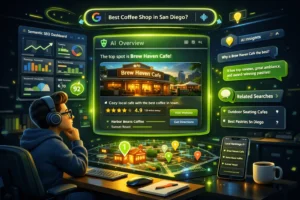
Local Businesses Rank In Google How Local Businesses Can Rank in Google AI Overviews in 2026 Book a Free Strategy Call See Case Studies FAQ
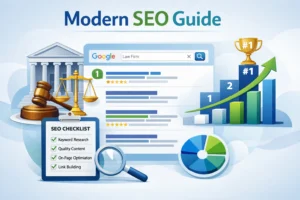
Local Law Firm SEO Law Firm SEO Guide: How Lawyers Rank #1 on Google Representative results from a client engagement. Identity protected by NDA. Book