Blog
Why 3 Companies Control 82% of Google Maps (And The Visibility Engineering™ Fix)
Roofing SEO Florida, USA The Florida Roofing Monopoly: Why 3 Companies Control 82% of Google Maps (And The Visibility Engineering™ Fix) Book a Free Strategy
We now offer Free AI Visibility Audits. Find out if ChatGPT, Perplexity & Google AI can find your business. Claim yours →
By Saumya Patel | Content Writer | 4+ Years of Industry Experience | Last Updated: June 14, 2026 | 17 min read
The real difference isn’t speed or cost — it’s what you own at the end. Paid ads are an expense: your cost per lead stays flat or rises forever, and the day you stop paying, you own nothing. Local SEO in the USA is an asset: cost per lead falls as rankings, reviews, and profile authority compound. In 2026, with average Google Ads CPC at $5.42 and rising in 87% of industries, the question isn’t which to pick — it’s how fast to shift from renting to owning.
Nearly every online article on this topic ends with the exact same shrug: “use both.” That is technically true, but completely useless — it tells you absolutely nothing about how much to allocate to each, when to shift your budgets, or why the two channels behave so differently.
This guide answers those questions with the model competitors skip: an asset-versus-expense framework, the crossover math that shows exactly when SEO overtakes ads, and a structured budget-rebalancing plan by stage. Plus, we reveal the most underreported local-search stat of 2026 — one that quietly demolishes the “AI killed SEO” panic.
Paid advertising still works. However, its baseline economics have quietly deteriorated for small local businesses:
For local businesses, this creates a frustrating treadmill: higher overall spend, flat conversion returns, and zero long-term equity.
Here is the structural reframe that changes the decision. Stop comparing ads and SEO as two identical ways to get leads. Instead, compare them as two fundamentally different ways to invest capital:
| Feature | Paid Ads (Expense) | Local SEO (Asset) |
|---|---|---|
| Cost per lead over time | Flat or rising | Falls steadily as assets mature |
| What you own after 12 months | Nothing | Rankings, reviews, profile authority |
| If you stop paying | Leads stop the same day | Leads continue to flow in |
| Compounding | None — resets monthly | Reviews and rankings steadily accumulate |
| Speed | Days | 3–6 months to traction |
| Best role | Immediate cash flow, gaps, seasonality | Durable, lower-cost lead engine |
The core principle: Ads buy you temporary visibility. Local SEO builds a permanent asset that produces visibility. When you stop paying for ads, you own nothing. When you temporarily pause SEO, you still fully own your rankings, your reviews, and your local profile. That distinction is the entire argument.
Is local SEO cheaper than paid ads?
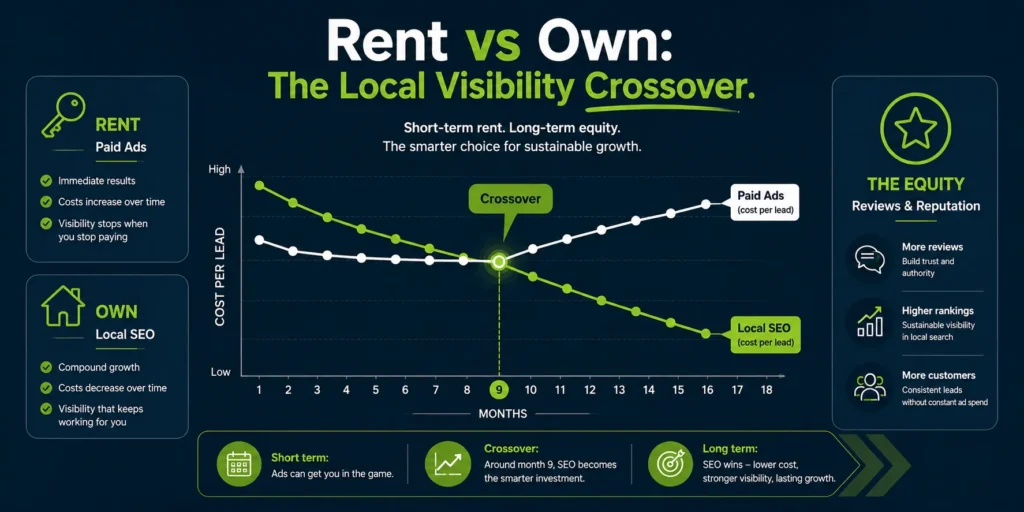
Direct answer: Not at first — but it becomes cheaper, permanently. Paid ads deliver leads immediately at a cost per lead that stays flat or rises. Local SEO costs more per lead in the first few months while assets are being built, then its cost per lead falls steadily as rankings, reviews, and citations compound. Most local businesses hit the crossover point somewhere between months 6 and 12, after which SEO is the cheaper channel indefinitely.
This illustrative model shows the dynamic that no comparison table captures — the two lines move in opposite directions:
| Period | Paid Ads CPL | Local SEO CPL | What’s Happening |
|---|---|---|---|
| Months 1–3 | $85 | — (Building) | SEO assets under construction; ads carry the lead volume. |
| Months 4–6 | $85 | $120 | SEO begins producing, but sits above paid ads. |
| Months 7–12 | $90 | $55 | Crossover Point — SEO becomes the cheaper channel. |
| Month 12+ | $95+ | $30 | Ads remain flat or rise; SEO compounds downward. |
Note: Read the overall trend, not just the hard numbers. (These figures are an illustrative model, not a guaranteed result — your local market sets the real values). Ads move up and to the right. SEO moves down. Every month you delay starting SEO is another month you push that crossover point further away — while continuing to pay rent to Google.
You have likely heard the industry panic: AI Overviews are eating up clicks, zero-click searches are destroying organic reach, and SEO is supposedly dead. For high-level informational queries, there is indeed truth to this — studies show click-through rate drops of 34% to 46% when an AI summary sits at the top of the page.
But here is the critical stat almost nobody is reporting: AI Overviews appear in only about 7% of local searches. The “AI killed search” narrative barely touches high-intent local queries. When a consumer searches “plumber near me” or “dentist open now,” Google still serves a standard, high-converting Local Map Pack — not an AI essay. If you run a localized business, local SEO is more relevant in 2026, not less.
Meanwhile, referrals from conversational AI assistants (like ChatGPT Search, Gemini, and Perplexity) have grown by 357% year-over-year. While still a small absolute volume, it is the fastest-growing discovery channel available. Crucially, conversational AI engines assemble their local recommendations from the exact same digital signals that drive local SEO: your Google Business Profile, active reviews, clean citations, and highly authoritative local content. Winning local SEO is now your direct ticket to winning AI visibility too.
Treat your marketing budget like a strategic investment portfolio, separating your visual assets into three clear holdings:
| Holding Type | What It Is | Its Job | Cost Behavior |
|---|---|---|---|
| Rented | Google Ads, LSAs, Social Ads | Generate immediate leads today; fill booking gaps and seasonal dips. | Flat/rising cost; stops completely when unpaid. |
| Owned | Google Business Profile, Local SEO, City Pages | Build a durable, compounding local lead engine. | Cost per lead steadily falls over time. |
| Earned | Customer reviews, Referrals, Reputation | Command high user trust, convert prospects, and break competitor ties. | Near-zero direct cost; highly compounding. |
The common mistake small businesses make is keeping 100% of their budget in Rented space. A healthy marketing portfolio uses paid ads to fund the construction of your Owned and Earned assets — then systematically rebalances as those organic assets mature.
Should small businesses shift budget from ads to local SEO?
Direct answer: Yes — but do it gradually, not all at once. Start paid-heavy to maintain immediate cash flow while your local SEO assets are built out, then steadily shift your budget toward SEO as organic rankings and customer reviews compound. A common path is 70/30 paid-to-SEO in the first six months, transitioning to a 50/50 split by months 6–12, and settling at 30/70 after twelve months — retaining paid ads strictly for seasonal shifts and highly specialized services.
| Stage | Paid Ads % | Local SEO % | Strategic Purpose |
|---|---|---|---|
| Months 0–6 | 70% | 30% | Paid ads carry immediate lead flow while SEO assets are constructed. |
| Months 6–12 | 50% | 50% | SEO begins to hit its crossover point; acquisition costs begin to converge. |
| Month 12+ | 30% | 70% | SEO is now your cheapest channel; ads are retained for tactical campaigns. |
Never fully drop your paid ads budget to zero. Keep a tactical share active to navigate sudden storm seasons, cover sudden schedule gaps, launch new physical locations, or win high-margin emergency services where raw speed is worth paying for.
Balanced marketing strategies matter. To be fully transparent, paid ads remain your superior choice under the following conditions:
Local search optimization yields the highest, most durable returns in industries where user trust, rapid physical proximity, and local reviews drive the hiring decision:
Google Maps serves as the primary gateway for local commerce. If your business holds a dominant Map Pack position backed by consistent reviews and accurate, matching local directory signals, you gain a stream of inbound visibility that operates even when your paid ads are paused. This is the ultimate expression of building an owned asset. For the exact technical mechanics of winning this space, see our Google Maps SEO guide.
Partnering with an experienced USA-based local SEO agency helps you bypass the common errors — such as thin geographic pages, inconsistent directories, and ignored reviews — that stall out most in-house marketing attempts.
Local SEO in the USA isn’t simply “better” than paid advertising in a vacuum. It is a fundamentally different kind of spending. Ads rent you visual real estate at an acquisition cost that never improves. Local SEO builds a tangible business asset whose cost per lead falls with every month it matures — and which continues to capture leads long after your marketing budget is paused.
Deploy paid ads for immediate speed. Invest in local SEO to own the digital ground. Rebalance your portfolio deliberately, because every month you spend renting is a month you didn’t spend building your own asset.
Get a completely free local visibility audit from Tarasaka along with a custom channel-rebalancing plan built around your real numbers.
Local SEO in the USA is the process of optimizing a business to appear in Google Maps, the Local Pack, and “near me” searches so nearby customers can find, trust, and contact it. It centers on your Google Business Profile, reviews, local citations, and location-specific website content.
Is Local SEO better than paid ads for small businesses?
They’re different kinds of spending. Ads are an expense — cost per lead stays flat or rises, and leads stop when you stop paying. Local SEO is an asset — cost per lead falls as rankings and reviews compound. 75% of small businesses report local SEO generates more leads than paid advertising alone, but ads still win when you need leads immediately.
How does “local SEO services near me” work?
When someone searches “near me,” Google weighs relevance, distance, and prominence — your Google Business Profile completeness, review signals, citation consistency, and local website content — to decide which businesses appear in the Local 3-Pack. Local SEO strengthens exactly those signals.
How long does Local SEO take to show results in the USA?
Most businesses see measurable improvement in 3–6 months, with competitive markets taking longer for full authority. The important milestone is the crossover point — typically months 6–12 — when SEO’s cost per lead drops below what you’re paying for ads, and stays there.
Did AI Overviews kill local SEO?
No. AI Overviews appear in only about 7% of local searches — “near me” queries still return a Map Pack, not an AI essay. Local intent is the most AI-resistant part of search, and AI assistants draw their local recommendations from the same signals local SEO builds.

Saumya Patel is a Content Writer at Tarasaka Digital Solutions with over 4 years of experience creating SEO-focused content for businesses across multiple industries. Her areas of expertise include SEO, Local SEO, AI SEO, AEO (Answer Engine Optimization), GEO (Generative Engine Optimization), content strategy, and digital marketing.
At Tarasaka Digital Solutions, Saumya researches search trends, analyzes ranking factors, studies AI search behavior, and creates evidence-based content designed to help businesses improve online visibility, attract qualified leads, and build long-term organic growth. His content is developed using industry best practices, competitor analysis, and real-world search marketing insights to ensure accuracy, relevance, and practical value for readers.
Roofing SEO Florida, USA The Florida Roofing Monopoly: Why 3 Companies Control 82% of Google Maps (And The Visibility Engineering™ Fix) Book a Free Strategy

Healthcare SEO Cost How Much Does Healthcare SEO Cost in India? Book a Free Strategy Call See Case Studies Healthcare SEO in India 2026: Pricing,

SEO Services Ahmedabad SEO Services in Ahmedabad 2027: Pricing, Strategies, Results & What to Expect Book a Free Strategy Call See Case Studies SEO Services