Blog
Law Firm SEO vs PPC: Which Generates More Legal Clients in 2026?
Law firm seo vs ppc Law Firm SEO vs PPC: Which Generates More Legal Clients in 2026 Book a Free Strategy Call See Case Studies
We now offer Free AI Visibility Audits. Find out if ChatGPT, Perplexity & Google AI can find your business. Claim yours →
By Saumya Patel | Content Writer | 4+ Years of Industry Experience | · Updated 2026 · ~13 min read
LLMs.txt does not help you rank in Google Search or AI Overviews — and as of 2026, this isn’t just a comment from a Google engineer anymore. Google’s official AI-optimization guide, updated June 15, 2026, states plainly that Search “ignores” the file entirely. If you want to show up in AI Overviews, the answer is still what it was in 2025: standard SEO services — helpful content, E-E-A-T, schema, Core Web Vitals, and topical authority.
On July 24, 2025, Google’s Gary Illyes put an end to a growing SEO myth at Search Central Live: Google doesn’t crawl llms.txt files, and if you want to rank in AI Overviews, the advice is just normal SEO.
A year later, that offhand comment has become official policy. This update covers what’s changed since — including a genuinely confusing new wrinkle involving Chrome DevTools — and what still matters for small business owners, coaches, and consultants trying to show up in Google’s AI-driven results in 2026.
Has Google’s position on llms.txt changed since 2025?
Direct answer: It’s been confirmed and formalized, not reversed. On May 15, 2026, Google published its first official AI-optimization guide, explicitly listing llms.txt — alongside AI-specific content chunking, AI-only rewriting, and special schema — as tactics that do not help visibility in Google Search, AI Overviews, or AI Mode. A June 15, 2026 update added even more direct language: keeping an llms.txt file ‘will neither harm nor help your site’s visibility or rankings in Google Search, as Google Search ignores them.’
The guide also did something bigger: it collapsed the whole GEO & AEO optimization vocabulary debate back into a simple answer. Asked whether SEO is still relevant for generative AI search, Google’s position is — in short — yes. The underlying work of ranking well hasn’t changed; what changed is that Google finally wrote it down in one place instead of leaving it to conference-talk comments and forum replies.
Here’s the part that trips people up in 2026. Around the same time Google Search was telling site owners to ignore llms.txt, the Chrome DevTools team added an ‘Agentic Browsing’ audit category to Lighthouse — and one of its checks verifies whether an llms.txt file exists at your domain’s root.
That’s not a contradiction once you separate the two systems. Google Search (the ranking system behind organic results and AI Overviews) ignores the file. Chrome’s agentic tooling checks for it because it’s relevant to a completely different use case: AI browser agents and coding tools navigating a site on a user’s behalf. Two different Google teams, two different jobs — one has nothing to do with your rankings.
Should I create an llms.txt file in 2026?
Direct answer: Not for SEO or AI Overview visibility — skip it if that’s your only goal. It’s a different story if you run a documentation-heavy or developer-facing site: AI coding tools like Claude Code and Cursor do read llms.txt, and it functions as a legitimate machine-readable summary for AI agents, not search engines. For most small businesses, coaches, and consultants, that use case doesn’t apply, and normal SEO remains the entire answer.
Independent traffic analysis backs this up at scale: across hundreds of millions of logged AI bot requests, the crawlers that actually drive citations — the ones tied to search and answer surfaces — touch llms.txt in a statistically negligible share of visits. One large-scale study of roughly 300,000 domains found llms.txt adoption showed no measurable correlation with AI citation rates at all.
Google’s own May 2026 guide grouped several “AI SEO” tactics together as things that don’t help. Worth listing them explicitly, because llms.txt isn’t the only myth in circulation:
| Fake signal (skip it) | Real signal (do this instead) |
|---|---|
| llms.txt / AI-only markdown files | Helpful, well-structured HTML content Google already crawls |
| AI-specific content ‘chunking’ | Clear headings and logical structure that serve human readers first |
| Special ‘AI schema’ or AI-only markup | Standard schema.org types — Organization, LocalBusiness, FAQ, Article |
| Rewriting content specifically ‘for AI’ | Writing clearly for the person searching, which AI systems read the same way |
The pattern: every fake signal is something a site owner controls and declares about themselves — exactly what Google has spent two decades learning to distrust. John Mueller made this explicit, comparing llms.txt to the old keywords meta tag: a self-declared file describing what a site claims to be about, when Google would rather just read the site directly. Every real signal, by contrast, is something Google verifies by actually crawling and evaluating your content.
The verified checklist, still holding up a year later:
Before you hit publish, run through this checklist tailored for optimizing your site’s presence across Google AI Overviews for local businesses:
| Task | Why it matters |
|---|---|
| Keyword in H1 and meta title | Gives Google immediate context |
| Main intent answered in ~100 words | Ideal length for an AI snippet extraction |
| Internal links added | Boosts crawl depth and topical connection |
| Schema markup present | Standard structured data — essential for trust signals |
| Author bio added | Direct E-E-A-T proof |
| Mobile UX tested | Required given mobile-first indexing |
| Site loads quickly | Core Web Vitals contribution |
Worth addressing directly, since Google’s May 2026 guide effectively folded the AEO/GEO vocabulary back into plain SEO. The terminology debate is mostly semantic — the underlying tactics that make content extractable and citable by AI systems (clear structure, direct answers, genuine authority, standard schema) are the same tactics that rank well organically. “GEO” and “AEO” are useful shorthand for optimizing specifically for how AI systems extract and cite content, but they describe an emphasis within SEO, not a separate rulebook that runs on different signals.
You don’t need hacks. You need to show up with value, again and again.
Whether you’re a life coach in Chicago or a SaaS founder in Dubai, AI Overviews reward consistency, trust, and clarity — the same way classic SEO did, but now with less room for fluff. If this applies to your niche, explore how targeted strategy plays out in our guide to SEO for coaches in Atlanta, or take a look at our specialized solutions for coaches and consultants for a deeper breakdown.
So yes — normal SEO still works. A year later, Google put it in writing.
DM “AI READY” on LinkedIn or reach out directly — we’ll review your website, content, and schema, and show you what needs fixing.
A proposed plain-text file, placed at a site’s root, meant to summarize a site’s content for AI tools to read — similar in concept to robots.txt. Google has confirmed on the record, and now in official documentation, that Search doesn’t use it.
Does llms.txt affect Google Search or AI Overviews?
No. Google’s AI-optimization guide, updated June 15, 2026, states directly that Search ignores the file entirely — it neither helps nor hurts visibility in organic results, AI Overviews, or AI Mode.
How do I rank in AI Overviews?
The same way you rank organically: helpful, intent-matched content, real E-E-A-T signals (named authorship, credentials, trust), standard schema markup, strong Core Web Vitals and mobile UX, and internal linking that builds topical authority in a focused niche.
I'm a remote coach. Can I still show up in 'near me' searches?
Less relevant for you specifically — ‘near me’ intent matters most for location-bound businesses. Focus instead on building topical authority and E-E-A-T in your niche, since that’s what drives visibility for a location-independent service.
No. Google’s 2026 guidance reinforced that AI Overviews and AI Mode pull from the same underlying index and ranking systems as classic search — which means the fundamentals of good SEO matter as much as ever, not less.

Saumya Patel is a Content Writer at Tarasaka Digital Solutions with over 4 years of experience creating SEO-focused content for businesses across multiple industries. Her areas of expertise include SEO, Local SEO, AI SEO, AEO (Answer Engine Optimization), GEO (Generative Engine Optimization), content strategy, and digital marketing.
At Tarasaka Digital Solutions, Saumya researches search trends, analyzes ranking factors, studies AI search behavior, and creates evidence-based content designed to help businesses improve online visibility, attract qualified leads, and build long-term organic growth. His content is developed using industry best practices, competitor analysis, and real-world search marketing insights to ensure accuracy, relevance, and practical value for readers.
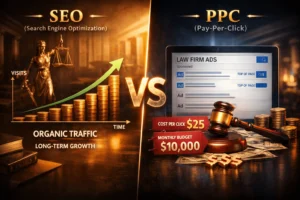
Law firm seo vs ppc Law Firm SEO vs PPC: Which Generates More Legal Clients in 2026 Book a Free Strategy Call See Case Studies

Local Businesses Rank In Google How Local Businesses Can Rank in Google AI Overviews in 2026 Book a Free Strategy Call See Case Studies FAQ
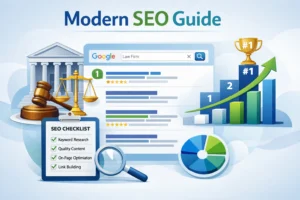
Local Law Firm SEO Law Firm SEO Guide: How Lawyers Rank #1 on Google Representative results from a client engagement. Identity protected by NDA. Book