Blog
Why 3 Companies Control 82% of Google Maps (And The Visibility Engineering™ Fix)
Roofing SEO Florida, USA The Florida Roofing Monopoly: Why 3 Companies Control 82% of Google Maps (And The Visibility Engineering™ Fix) Book a Free Strategy
We now offer Free AI Visibility Audits. Find out if ChatGPT, Perplexity & Google AI can find your business. Claim yours →
By Saumya Patel | Content Writer | 4+ Years of Industry Experience | Last Updated: August 31, 2026 | ~16 min read
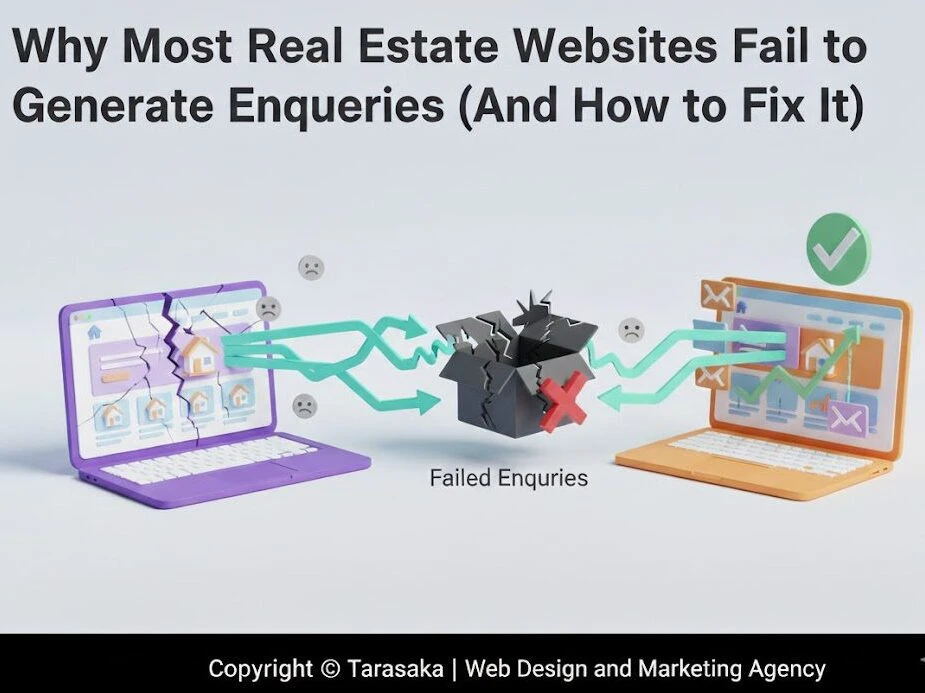
Most real estate websites fail to generate enquiries because they’re built as brochures — about the business, not the visitor. But the deeper, less-discussed cause is speed: agents who respond within 5 minutes are 21x more likely to qualify a lead, yet the average response time is over 15 hours. A real estate lead generation website only works when clarity, local visibility, and fast follow-up operate as one connected system — not three separate projects.
You invested in a website expecting one outcome: enquiries. It looks professional, loads fine, gets some traffic. And yet the phone stays quiet. This isn’t rare — it’s the default outcome of building a brochure and hoping it behaves like a lead-generation system.
This guide goes further than “clarify your messaging.” It gives you the Enquiry System Blueprint — five connected stages — and the response-speed math that most real estate marketing advice leaves out entirely. Explore how a system like this works on our real estate website development page.
The biggest mistake is simple: the website talks about the business, not the visitor. Most real estate sites lead with company background, project photos, long descriptions, and awards — and never answer the one question that actually matters.
Why do most real estate websites fail to generate enquiries?
Direct answer: Because they’re built as brochures instead of enquiry-focused systems. A real estate website should answer “why should I contact you?” within seconds — and connect that answer to local visibility and fast follow-up. If a visitor has to hunt for the reason to act, or an enquiry sits unanswered for hours, the website has already failed regardless of how it looks.
Design supports conversion; it doesn’t create it alone. Real estate websites fail when calls to action are missing, contact forms are buried, information is scattered across pages, and visitors are left to “figure it out.” A property-development site can win design awards and still generate zero enquiries if a buyer can’t find the one button that matters.
Here’s the data that separates this guide from every other “fix your website” article: what happens after someone submits an enquiry matters as much as the website itself.
| Metric | 2026 Figure | What It Means |
|---|---|---|
| Response-time advantage | 21x more likely to qualify a lead within 5 minutes | Speed beats almost everything else |
| Average agent response time | 15+ hours | Most leads go cold before anyone replies |
| First-responder win rate | 78% of buyers work with whoever replies first | Being fast matters more than being best |
| Touchpoints needed | 6+ contacts = 70% higher conversion | One follow-up email isn’t a system |
The insight: a beautifully redesigned website connected to a 15-hour response time is still a broken system. Clarity gets the enquiry started; speed decides whether it survives.
Even a well-designed site fails if people can’t find it. Many real estate businesses have poor local search visibility, a weak or unoptimized Google Business Profile, and no location relevance built into the website itself. The result: traffic exists, but it isn’t local or qualified. Real estate website development has to work together with local SEO — without that connection, enquiries stay inconsistent no matter how the site is designed.
Owners search “real estate website development near me” expecting local leads to follow automatically. They don’t — “near me” traffic only converts when the site clearly explains services, shows genuine local relevance, and makes contact effortless. Without those three elements, location-based traffic behaves exactly like any other traffic: it bounces. (The same principle governs paid vs organic local visibility more broadly — see our comparison of local SEO vs paid ads.)
Most visitors don’t arrive ready to enquire — they’re exploring, sizing up whether the business feels trustworthy and what happens if they reach out. Many sites fail because there’s no flow, no direction, no reassurance. An enquiry-focused site anticipates hesitation and removes it before the visitor has to ask.
Fixing enquiry problems isn’t a redesign — it’s connecting five stages that most real estate websites treat as unrelated projects. Miss any one, and the ones before it are wasted effort:
| Stage | What It Does | Where It Breaks |
|---|---|---|
| 1. Attract | Local SEO + Google Business Profile bring in the right visitors | Weak visibility → traffic is present but not local or qualified |
| 2. Clarify | Above-the-fold messaging answers ‘why contact you’ in seconds | Brochure copy about the business, not the visitor |
| 3. Guide | Page flow builds trust and removes hesitation step by step | No direction — visitor left to ‘figure it out’ |
| 4. Capture | Simple enquiry paths on every key page, not just one contact page | Forms buried, too long, or hard to find |
| 5. Follow-up | CRM + automation respond in minutes, not hours | 15-hour average response kills otherwise-good leads |
The principle: a website is not a finished asset — it’s the front door of a system. Attract without Clarify wastes traffic. Clarify without Follow-up wastes enquiries. Every stage multiplies the ones before it, and every stage skipped caps what the others can achieve.
A real estate website shouldn’t exist alone. It should connect to local SEO and Google Business Profile visibility, lead capture and call tracking, a CRM or enquiry management tool, and simple follow-up automation. This is exactly where most real estate websites break — they stop at launch. A real estate lead generation website keeps working after the visitor leaves the page.
Are website leads cheaper than portal leads for real estate?
Direct answer: Yes, significantly. Content and website-driven leads run roughly $7–$15 each, while portal leads (Zillow, Realtor.com) average $181–$503+ with conversion rates of just 0.4–1.2%. A well-built, locally visible website is one of the lowest-cost, most durable lead sources available — it just requires the full system, not a static page, to actually convert.
The trajectories are moving in opposite directions: portal lead costs have risen over 1,000% since 2015, while content-driven costs have fallen. That’s the same asset-vs-rented-visibility dynamic that applies across every local industry — the business that owns its enquiry system keeps winning as paid channels get more expensive.
These problems are common — and this fix applies — across real estate developers, builders and construction companies, brokerage firms, property consultants, and multi-location real estate businesses. If your business depends on online enquiries, a broken stage anywhere in the system directly caps growth.
The first step isn’t design — it’s a diagnostic. Ask these four questions about your current site:
If the answer is “no” to any of these, the website is underperforming — and the fix is aligning structure, visibility, and follow-up speed, not necessarily a full rebuild.
A real estate website should not just exist — it should work, as one connected system: visible enough to be found, clear enough to be understood in seconds, structured enough to guide a hesitant visitor, easy enough to enquire through, and fast enough to follow up before the lead goes cold.
When real estate website development is approached this way, enquiries become predictable instead of random. That’s the gap between a website that looks good and one that supports the business.
Get a free enquiry-system audit from Tarasaka Digital Solutions.
Why do most real estate websites fail to generate enquiries?
Because they’re built as brochures instead of enquiry-focused systems that guide visitors toward action. They also frequently fail on the follow-up side — agents take an average of 15+ hours to respond to leads, by which point 78% of buyers have already committed to whoever answered first.
Does redesigning a real estate website guarantee more leads?
No. A redesign can fix unclear messaging and poor page flow, but if local visibility is weak or follow-up is slow, enquiries still won’t convert. The website is one stage of a five-stage system — Attract, Clarify, Guide, Capture, and Follow-up all have to work together.
How important is local SEO for real estate websites?
Very. Even a well-designed site fails if people can’t find it. Without strong local visibility and an optimized Google Business Profile, traffic exists but isn’t local or qualified — which is why local SEO and website structure have to be built together, not separately.
Can small real estate businesses compete with larger firms online?
Yes. Speed and system design matter more than budget. A small firm that responds within 5 minutes, has clear above-the-fold messaging, and follows up consistently will out-convert a larger competitor whose leads sit unanswered for hours.
How fast should a real estate business respond to a website enquiry?
As close to immediately as possible. Agents who respond within 5 minutes are 21x more likely to qualify a lead, and 78% of buyers end up working with whoever responds first — response speed is one of the highest-leverage, most overlooked factors in real estate lead conversion.

Saumya Patel is a Content Writer at Tarasaka with over 4 years of experience creating SEO-focused content for businesses across multiple industries. Her areas of expertise include SEO, Local SEO, AI SEO, AEO (Answer Engine Optimization), GEO (Generative Engine Optimization), content strategy, and digital marketing.
At Tarasaka, Saumya researches search trends, analyzes ranking factors, studies AI search behavior, and creates evidence-based content designed to help businesses improve online visibility, attract qualified leads, and build long-term organic growth. His content is developed using industry best practices, competitor analysis, and real-world search marketing insights to ensure accuracy, relevance, and practical value for readers.
Roofing SEO Florida, USA The Florida Roofing Monopoly: Why 3 Companies Control 82% of Google Maps (And The Visibility Engineering™ Fix) Book a Free Strategy

Healthcare SEO Cost How Much Does Healthcare SEO Cost in India? Book a Free Strategy Call See Case Studies Healthcare SEO in India 2026: Pricing,

SEO Services Ahmedabad SEO Services in Ahmedabad 2027: Pricing, Strategies, Results & What to Expect Book a Free Strategy Call See Case Studies SEO Services