
Blog
Why 3 Companies Control 82% of Google Maps (And The Visibility Engineering™ Fix)
Roofing SEO Florida, USA The Florida Roofing Monopoly: Why 3 Companies Control 82% of Google Maps (And The Visibility Engineering™ Fix) Book a Free Strategy


The System That Turns Spend Into Booked Jobs
By Saumya Patel | Content Writer | 4+ Years of Industry Experience | Last Updated: June 12, 2026 | ~16 min read
INTRODUCTION
A roofing marketing strategy is a system that combines instant channels (Google Local Services Ads, Google Ads) with compounding channels (Local SEO, Google Business Profile, content) and conversion infrastructure (website, reviews, tracking). The winning move in 2026 isn’t picking a channel — it’s sequencing them so paid funds the build-out of owned, and every dollar is judged by cost per booked job, not cost per lead.
Most roofing marketing guides hand you a list of 10 channels and say “do all of them.” That’s not a strategy — it’s a to-do list with no order and no budget logic. It’s also why most roofers spread money thin and grow inconsistently.
This guide gives you the system instead — the Roofing Growth System — with a phase-by-phase rollout, a budget-allocation model, and the one metric that keeps it honest. If you want it implemented for you, explore our roofing SEO services.
First principles: marketing channels aren’t interchangeable items to check off — they play different roles at different stages, and they depend on each other. Paid ads with no conversion-ready website waste spend. SEO with no reviews can’t win the Map Pack. Doing everything at once, badly, beats doing nothing — but loses to doing the right things in the right order.
Don’t ask “which channels should we use?” Ask “what sequence turns the next dollar into a booked job fastest — and lowers the cost of the dollar after it?” That ordering is the entire strategy.
Every roofing marketing channel fits one of three jobs. Build them as a system, not a menu:
| Pillar | Channels | Job | Cost Behavior |
|---|---|---|---|
| 1. Convert | Website, CTAs, reviews, call tracking | Turn any visitor into a booked job | Fixed; multiplies every other channel |
| 2. Capture (Owned) | Local SEO, Google Business Profile, content | Compounding lead flow | $5–$15/lead once built; durable |
| 3. Accelerate (Paid) | Local Services Ads, Google Ads, retargeting | Instant volume now | $50–$220/lead; stops when paused |
The order matters: Convert first (or you waste every lead), then Capture to build durable flow, then Accelerate to fill the gap while Capture matures. Most roofers do the reverse — buy ads, send them to a weak website, and never build owned channels.
Every channel funnels to your website and phone, so conversion is the multiplier on all marketing spend. Double your conversion rate and you halve your cost per booked job across every channel at once. A roofing site that converts loads fast, works on mobile, puts click-to-call and a quote form above the fold, shows real reviews and project photos, and answers fast — responding within five minutes dramatically out-books responding in an hour. Fix this before spending on traffic.
This is the durable core. An optimized Google Business Profile (correct categories, service areas, photos, reviews, posts) wins the Map Pack, where most “roof repair near me” searches convert. Local SEO with unique city pages (“Roofing Contractor Tampa,” “Roof Repair Miami”) and educational content (storm-damage guides, repair-vs-replace, cost ranges) ranks for what homeowners actually search — and feeds AI Overviews and ChatGPT. Once built, these leads cost a fraction of paid and don’t stop when you stop spending.
Local Services Ads are the fastest ROI in roofing: pay-per-lead, top placement, and a “Google Guaranteed” badge homeowners trust. Google Ads capture high-intent and storm-damage searches; retargeting recovers visitors who didn’t convert. Use paid to keep crews busy now — and to fund the content and local work that lowers your lead cost over the next year.
How should roofing companies measure marketing results?
Direct answer: By cost per booked job, not cost per lead. Cost per booked job = cost per lead ÷ close rate. A $50 lead that closes at 10% costs $500 per job; a $12 SEO lead that closes at 20% costs $60. Tracking leads alone hides which channels are actually profitable — always measure to the booked job.
| Channel | Cost Per Lead | Close Rate | Cost Per Booked Job |
|---|---|---|---|
| Shared Leads (Angi) | $50 | 10% | $500 |
| Google Local Services Ad | $90 | 25% | $360 |
| Local SEO (Once Established) | $12 | 20% | $60 |
That contrast is the whole argument for building owned channels. Owned leads don’t just cost less — they cost a fraction per booked job. (Figures are illustrative blends of 2026 channel data; your close rates set the real numbers.)
Where the next dollar goes depends on what you’ve already built. A rough allocation model across development stages:
| Stage | Convert | Accelerate (Paid) | Capture (Owned) |
|---|---|---|---|
| Just Starting | Fix First | 60% | 40% |
| Growing | Maintain | 45% | 55% |
| Established | Optimize | 30% | 70% |
The trajectory is deliberate: start paid-heavy for instant cash flow, then systematically shift toward owned as it compounds. Within 12–18 months, a strong owned-content engine can cut paid lead costs 40–60% while raising total volume — the definitive payoff for building instead of renting forever.
A practical sequence to launch the entire system efficiently without administrative overwhelm:
Roofing demand spikes aggressively following localized storms and shifts predictably across annual calendar seasons. Storm-damage searches surge overnight, and paid marketing channels let you open a tap to capture that demand instantly while it lasts.
The strategic play: Lean hard into Accelerate avenues during storm spikes and peak seasons, then use that immediate revenue to fund your Capture content pipelines. This compounds beautifully through the slower winter months, preventing you from starting back from a complete dead stop every spring.
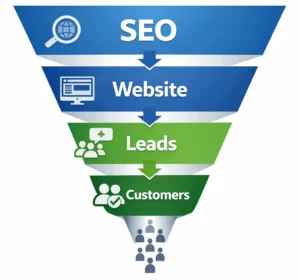
A successful roofing marketing strategy isn’t an unorganized list of channels — it’s a carefully sequenced system. Optimize Convert protocols first so nothing leaks, establish Capture pipelines to build compounding owned flow, and deploy Accelerate ads to fund operations today while judging every dollar by your final cost per booked job.
Stop spreading your budget thin across ten disconnected tactics. Build the Roofing Growth System in its correct operational order, and turn unpredictable customer referrals into a highly predictable pipeline.

Roofing SEO Florida, USA The Florida Roofing Monopoly: Why 3 Companies Control 82% of Google Maps (And The Visibility Engineering™ Fix) Book a Free Strategy

Healthcare SEO Cost How Much Does Healthcare SEO Cost in India? Book a Free Strategy Call See Case Studies Healthcare SEO in India 2026: Pricing,

SEO Services Ahmedabad SEO Services in Ahmedabad 2027: Pricing, Strategies, Results & What to Expect Book a Free Strategy Call See Case Studies SEO Services