Blog
Why 3 Companies Control 82% of Google Maps (And The Visibility Engineering™ Fix)
Roofing SEO Florida, USA The Florida Roofing Monopoly: Why 3 Companies Control 82% of Google Maps (And The Visibility Engineering™ Fix) Book a Free Strategy

By Saumya Patel | Content Writer | 4+ Years of Industry Experience | Last Updated: June 12, 2026 | 14 min read
Local SEO for roofing companies in 2026 works when your website, Google Business Profile, reviews, and messaging all tell the same local story. Ranking is no longer about isolated tactics or proximity alone — it’s about signal alignment. When your Maps listing and site agree, and users behave with confidence after finding you, local rankings stabilize and calls return.
Local SEO for roofing companies isn’t broken in 2026 — it’s misunderstood. Plenty of roofers are doing “all the right things”: an optimized Google Business Profile, collected reviews, and custom location pages built out. Yet, the calls still slow down.
The reason is simple, and almost no competitor names it: local SEO today isn’t a checklist of isolated tactics — it’s alignment. This guide reframes roofing local SEO around a proprietary model — the Local Signal Alignment Framework — and shows exactly what your business needs to fix first.
The biggest shift in roofing local SEO isn’t the introduction of more ranking factors — it’s that Google now heavily weighs how well your individual signals connect with one another. Three core metrics now matter more than any single standalone optimization tactic:
The reframe: Ranking is no longer just about proximity — it’s about local confidence. Google actively promotes roofers whose entire online footprint feels grounded in the area, not merely optimized for it.
Most roofers optimize each marketing element in total isolation — updating a profile here, requesting reviews there, and scattering landing pages somewhere else. Rankings stabilize only when these four signals point in the exact same direction:
| Signal | Aligned looks like… | Misaligned looks like… |
|---|---|---|
| 1. Website | Service areas, core categories, and specific offerings match your Maps data exactly. | A generic, templated site that never properly names the local areas you serve. |
| 2. Maps / GBP | Correctly optimized categories, defined services, verified photos, and realistic service boundaries. | A map listing that makes explicit commercial claims your website never mentions. |
| 3. Reviews | Recent, location-relevant feedback strategically featured at critical conversion points. | Reviews that technically exist but remain buried on external pages or third-party platforms. |
| 4. Messaging | On-page copy that speaks directly to homeowner reassurance, local proof, and reliability. | Keyword-stuffed paragraphs written specifically to manipulate search engine bots. |
The principle: Local SEO fails not because your market is overly competitive, but because your signals don’t agree. When your website, Maps setup, incoming reviews, and brand messaging tell one consistent story, visibility becomes predictable. That lack of agreement is where most roofing companies lose traction.
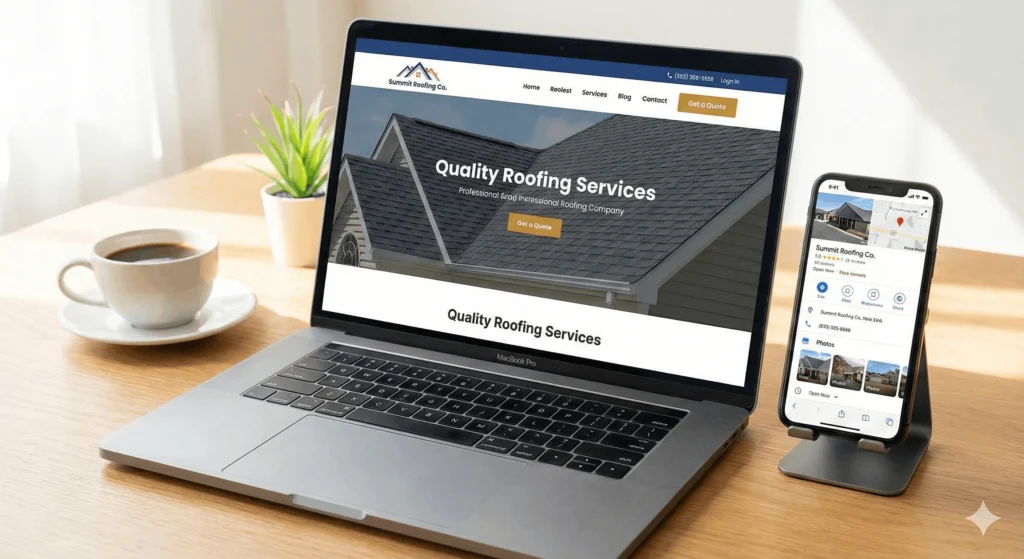
A Google Business Profile without a strong local website foundation is fragile. Your site should clearly name your primary service areas, match the exact categories and services listed on Maps, and reinforce consumer trust with real on-site photos and proof of work. When Maps and your website tell the exact same story, rankings stabilize. (This serves as the foundational layer in our roofing SEO checklist.)
Homeowners searching for “roofing near me” aren’t comparing technical optimization strategies. They are asking three quiet questions: Who is truly close? Who looks reliably established? Who feels safe to call? Pages structured to answer those urgent psychological concerns convert significantly better than keyword-heavy landing pages. For a breakdown of how these specific queries map out, see our guide to roofing SEO keywords.
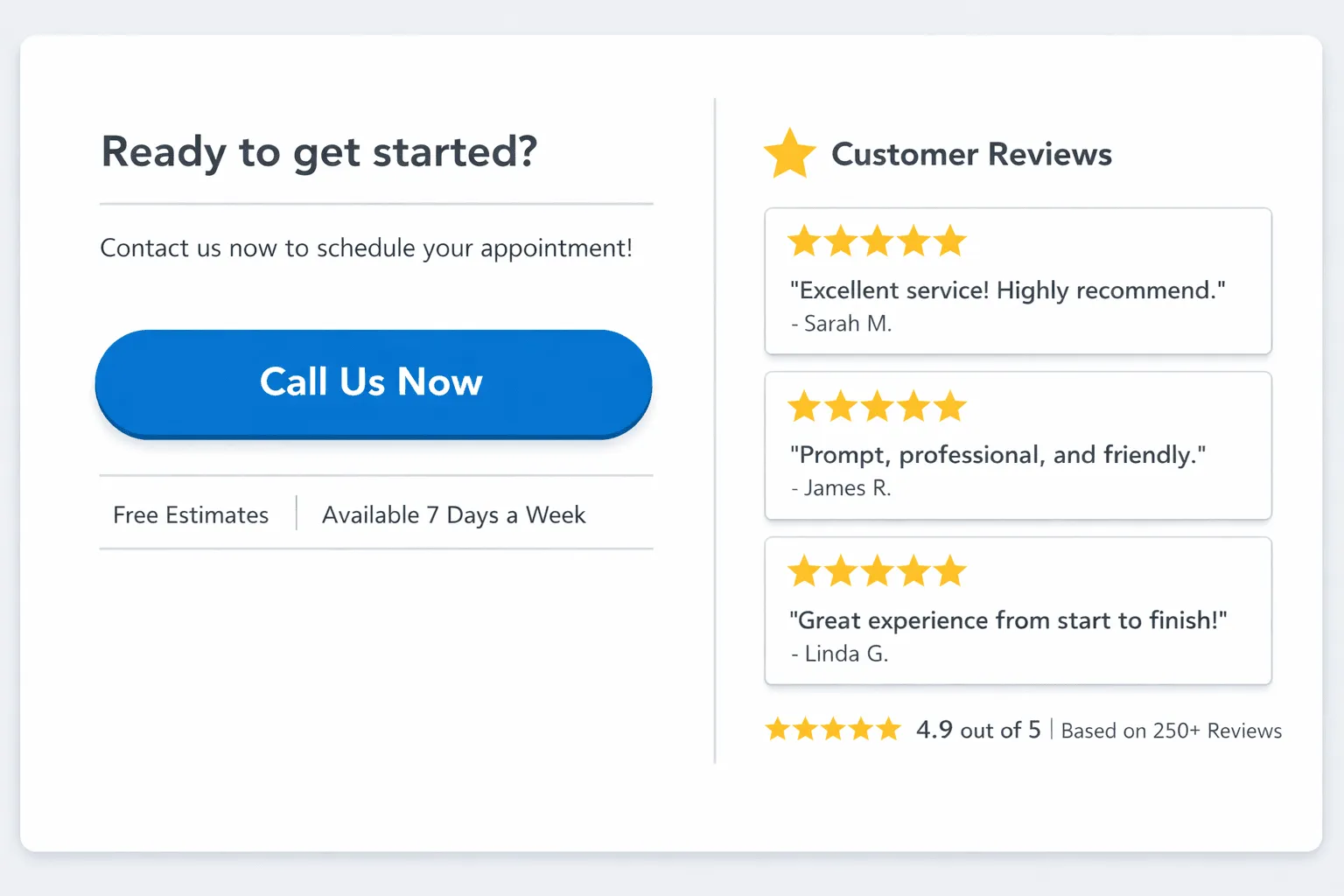
Reviews assist your map rankings — but they only generate calls when they are visible at the exact point of decision. Your site should surface recent, location-relevant user feedback and structural proof directly adjacent to calls-to-action or contact form fields. Trust delayed is trust denied. Reviews also remain the single highest controllable lever within our comprehensive Google Maps SEO guide for roofers.
Thin, programmatically generated city pages no longer help your business scale. A genuinely useful location page details specific regional roofing demands, references local climate vulnerabilities, notes regional storm patterns, or details prominent architectural housing types. Real quality always beats empty geographical coverage. Publishing thin, duplicated city pages is one of the foundational mistakes we flag in roofing SEO mistakes.
Whether your business operates out of Austin, Miami, San Diego, or Chicago, homeowner search behavior remains identical — users don’t care about technical SEO terminology, they care about absolute certainty. The contracting companies that win locally are those whose online presence feels natively grounded in the area rather than calculatedly optimized for it. A Miami landing page discussing hurricane-season roof preparation, or a Chicago page addressing severe ice dams, signals authentic regional relevance in a way a templated layout never can.
What should roofing companies prioritize for local SEO in 2026?
Direct answer: Prioritize signal alignment over raw volume. In order: (1) align website content with your Google Business Profile, (2) strengthen one or two core service-area pages, (3) improve review visibility — not just quantity, and (4) make mobile calls frictionless. These four alignment steps consistently outperform most “advanced” tactics.
If you are trying to decide between organic placement and paid channels to generate immediate project leads, compare local SEO vs paid ads in the USA (2026), and map out your full channel plan in our comprehensive roofing marketing strategy guide.
Local SEO for roofing companies doesn’t fail because your immediate market is too saturated. It fails because your external brand signals don’t agree. When your home site, map configurations, user feedback, and core messaging point the same way, local search visibility becomes highly predictable — and your inbound calls return.
Stop chasing fragmented, short-term search tactics. Align your four core signals, enrich a targeted set of real service-area pages, and place social proof exactly where homeowners make their hiring decisions.
Get a completely free local SEO alignment audit from Tarasaka alongside a prioritized checklist of immediate technical fixes.

Roofing SEO Florida, USA The Florida Roofing Monopoly: Why 3 Companies Control 82% of Google Maps (And The Visibility Engineering™ Fix) Book a Free Strategy

Healthcare SEO Cost How Much Does Healthcare SEO Cost in India? Book a Free Strategy Call See Case Studies Healthcare SEO in India 2026: Pricing,

SEO Services Ahmedabad SEO Services in Ahmedabad 2027: Pricing, Strategies, Results & What to Expect Book a Free Strategy Call See Case Studies SEO Services